

Clear records can keep a small jobsite disagreement from becoming a costly dispute. For Galveston projects, avoiding subcontractor disputes with better data means keeping scope, schedule updates, daily work records, costs, and change decisions in a clear project trail. Documenting expectations and changes as work unfolds helps teams address gaps before memories diverge.
Good communication matters, but it needs to be specific enough to guide decisions when work, timing, or responsibilities shift. Set expectations before work begins, keep schedules and costs current, document changes, and raise problems early. These practical steps create records that clarify responsibilities, support timely conversations, and help keep work moving.
Key Takeaways
- Align subcontractor scopes, drawings, milestone dates, and notice procedures before work begins so responsibilities stay clear.
- Set expectations for roles, handoffs, and communication, then raise emerging problems promptly with factual project records.
- Track job costs against the work completed to spot budget changes early and address the cause before it grows.
- Document field conditions and route changes through a clear review and approval process; Construction Intelligence can help teams monitor site progress.
1. Following contracts, drawings, schedules, and communication procedures
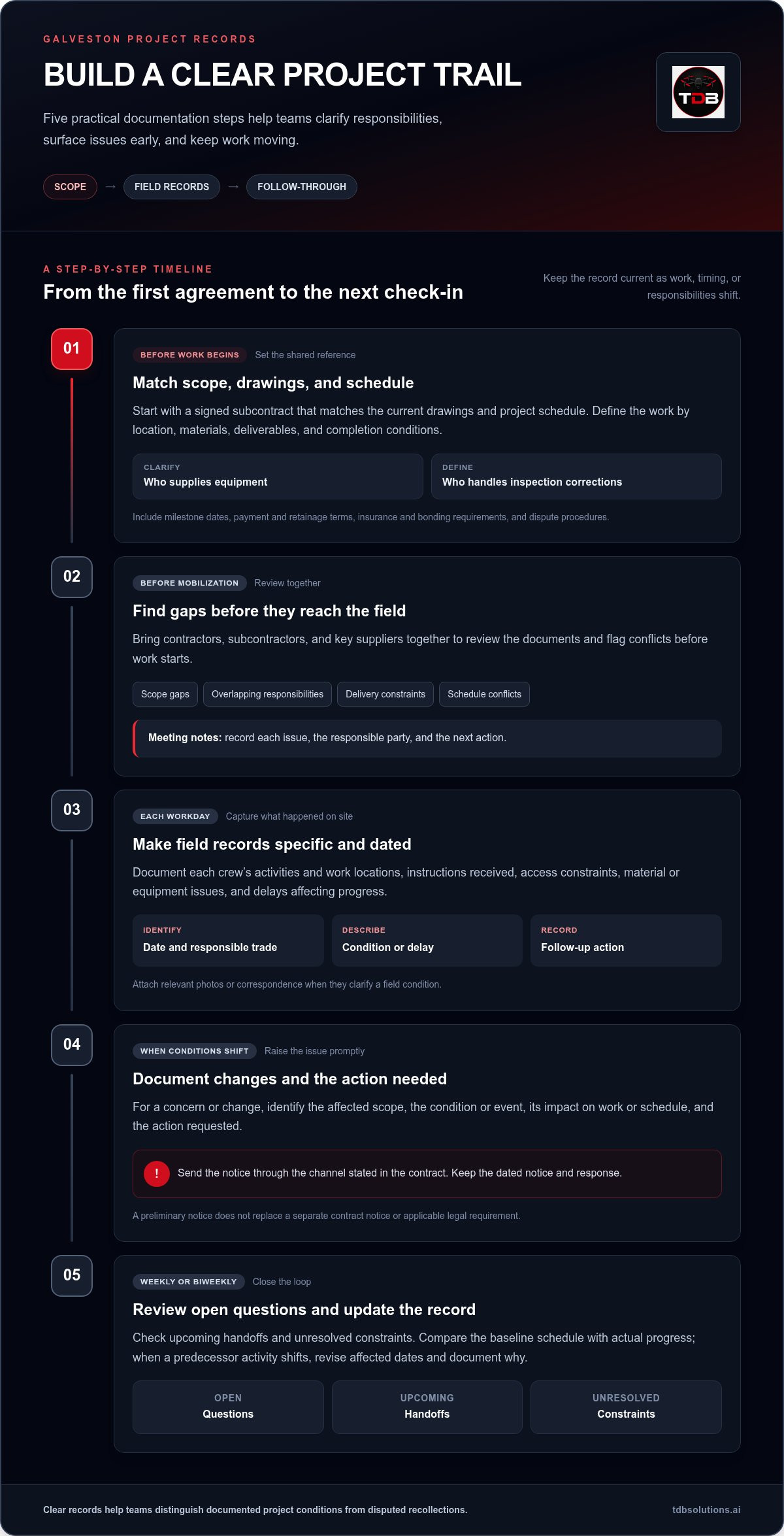
Start with a signed subcontract that matches the current drawings and project schedule. Define the work by location, materials, deliverables, and completion conditions. For example, specify who supplies equipment and who handles inspection corrections. Include milestone dates, payment and retainage terms, insurance and bonding requirements, and dispute procedures. Clear contract language gives contractors and subcontractors a shared reference when expectations conflict.
Review the documents together before mobilization. In coordination meetings, contractors, subcontractors, and key suppliers can identify scope gaps, overlapping responsibilities, delivery constraints, and schedule conflicts. Record each issue, the responsible party, and the next action in the meeting notes. Compare the baseline schedule with actual progress during updates. When a predecessor activity shifts, revise affected dates and document the reason so an outdated schedule does not remain in circulation.
Texas construction payment and claim disputes can involve the subcontract, applicable prompt-payment and lien laws, and project type. The contract should identify the governing documents and set procedures for payment applications, disagreements, and dispute resolution. These procedures work best when they reflect the project’s responsibilities and are followed consistently.
Texas prompt-payment deadlines depend on the applicable law, whether the project is public or private, and the payment event or application involved. Set out submission steps, the review process, and notice methods in the contract. Then track each event and response date against the applicable deadline.
For a claim passed through a contractor to an owner, a liquidation agreement can define financial exposure. It can limit the subcontractor’s recovery to damages awarded against and paid by the owner, require the subcontractor to cover legal fees for prosecuting the claim and defending an owner’s counterclaim, and state that the contractor brings the claim in its own name. Separately, follow contract notice requirements for timing and content. Preserve dated notices, schedule updates, meeting records, and responses so the team can distinguish a documented delay from a disputed recollection.
2. Setting project expectations and using preliminary notices
Before work starts, align the general contractor and each subcontractor on roles, deliverables, priorities, handoffs, and communication channels. Identify who supplies a material, approves a substitution, and reports an access delay. A written responsibility matrix gives project managers and field supervisors a practical reference when work crosses trades or planned sequences shift.
What should contractors document daily? Record each crew’s activities and work locations, instructions received, access constraints, material or equipment issues, and delays affecting progress. Note the date, responsible trade, and follow-up action. Attach relevant photos or correspondence when they clarify a field condition. These records distinguish completed work from reported issues and support accurate schedule discussions.
Use preliminary notices and other project communications to put important concerns on the record early. Identify the affected scope, the condition or event, its impact on work or schedule, and the action requested. Send the notice through the channel stated in the contract, and retain the dated notice and response. A preliminary notice does not replace a separate contract notice or applicable legal requirement.
Pass-through claims arise when a subcontractor’s claim against an owner moves through a contractor that holds the owner contract. In 2004, the Supreme Court of Texas recognized pass-through claims and set requirements for asserting them. Project managers should understand the claim path, record the subcontractor’s supporting facts, and escalate unresolved issues through the contract process. Supervisors can practice this workflow using sample delay reports and change requests.
Set a weekly or biweekly check-in to review open questions, upcoming handoffs, and unresolved constraints. Keep messages factual: identify the location, affected activity, decision needed, and response date. Avoid personal accusations; they distract from the work record. If visual context helps clarify site progress, explore aerial project documentation as one way to keep field conditions visible alongside written updates.
Clear construction contracts define scopes of work and assign responsibility for delays and other issues. Project participants should raise problems promptly and seek ways to mitigate them rather than ignore them. Construction records help prevent disputes by making project status clear and bringing issues to light early.
3. Real-time job costing and early issue detection
Shared project data helps contractors and subcontractors see whether spending matches completed work. Construction job-costing systems can update project costs in real time, giving teams an earlier view when a job moves off track. Track labor, materials, equipment, committed purchases, approved changes, and invoices against the relevant work package. For example, separate electrical rough-in from fixture installation so a cost variance points to a specific activity, not the entire trade scope.
Compare actual spending with the estimate and remaining work. A rising labor total could reflect added hours, rework, restricted access, or an inaccurate productivity assumption. Review time entries, delivery records, and progress information before assigning responsibility. Record the reason for each variance, who reviewed it, and the next action. For Galveston teams, avoiding subcontractor disputes with better data starts with a clear record of what changed and why.
Shared project data can prevent disputes when authorized participants can access the same current cost and progress records. Review discrepancies together. A shared view can reveal paid-for materials not yet delivered, completed work awaiting approval, or costs tied to a pending change request. This gives both sides a common basis for discussing the issue.
Keep cost codes consistent across estimates, purchase orders, invoices, and progress reports. If one team codes a delivery to general conditions while another assigns it to a subcontractor’s scope, comparisons become unreliable. Assign responsibility for entering and correcting each record, and preserve the original entry when making a correction. For Galveston projects, avoiding subcontractor disputes with better data also means matching each cost to its work package, supporting document, and approval status.
Use cost reviews to forecast the cost to finish, not just summarize past spending. If installed quantities lag behind labor charges, confirm work status and identify the constraint before the next invoice cycle. Share the finding with the affected subcontractor, document the agreed response, and update the forecast. Current, traceable data gives both parties a practical basis for resolving cost questions while work continues.
4. Change orders and unforeseen circumstances
A change order should show what changed, why it changed, and who approved the work. Tie each request to the affected drawing, specification, or field condition. Describe the added or removed work, schedule effect, and payment adjustment. Route it through the contract’s review process before the crew proceeds, unless the contract sets another procedure. Keep the request, supporting records, decision, and revised schedule together.
Recognize possible change triggers early, such as a concealed condition, design revision, delayed delivery, or written request that alters the subcontractor’s scope. Document what workers found, where they found it, and when they reported it. Add relevant photographs, delivery records, and instructions. Distinguish the observed condition from assumptions about its cause. Assign each risk to the party best positioned to prepare for or mitigate it.
For Galveston projects, permit conditions depend on the site and scope of work. Weather interruptions, flooding, or coastal site conditions may also affect access, sequencing, or materials. Use the project’s permit documents and contract terms to identify applicable constraints. If a storm disrupts access, record the affected area, work activity, dates, and resulting schedule change. A weather event alone does not establish responsibility; connect its documented impact to the work and contract.
Review each proposed change with the affected subcontractor, scheduler, and decision-maker. Confirm the revised scope, cost basis, responsible party, and effect on dependent trades. Then update the schedule and distribute the approved record to everyone affected. If work must proceed before final approval, document the direction, limits, and decision path under the contract. For clearer visual records of site conditions, discuss aerial documentation with the team.
Daily records help contractors and subcontractors reduce misunderstandings. Addressing requests for information and change orders proactively also helps keep questions and proposed modifications from being overlooked. A consistent process gives the team a defined way to review, approve, and document each proposed change. Allocate risks to the party best able to prepare for, assume, and mitigate them, aligning responsibility with the parties’ ability to manage the risk.
TDB Solutions: Construction Intelligence
TDB Solutions provides Construction Intelligence for teams that need clearer visual records of site progress. Regular aerial documentation, site progress reports, volumetric measurements, and overhead views give project teams another way to review jobsite conditions. Use these records alongside contracts, schedules, daily logs, and approved change documents. They can help teams compare visible progress over time and identify areas for follow-up.
Consider aerial documentation when ground-level updates leave gaps or project stakeholders need a consistent view of site conditions. Aerial records add context to coordination discussions, but they do not replace contract notices, cost records, or professional judgment. They are most useful within a disciplined documentation process that clearly identifies dates and project activities.
Contact TDB Solutions to discuss Construction Intelligence for your Galveston project.
Build a Clearer Project Record From Here
Make your next project decision easier to trace. Set a consistent process for recording field conditions, reviewing changes, and sharing current information with those responsible for the work. For Galveston teams, avoiding subcontractor disputes with better data means giving every decision a clear record and a practical next step.
TDB Solutions offers Construction Intelligence to support visual site documentation, as well as Custom Mobile-First Websites and Marketing Media Production for construction businesses that want to communicate their work clearly online. Choose the support that fits your immediate need, whether you are documenting project progress or improving how your company presents its capabilities.
Start a conversation about the records and visibility your projects need. Contact TDB Solutions to discuss your project, and take the next step with a clearer view of the work ahead.
Frequently Asked Questions
What are common causes of subcontractor disputes on Galveston construction projects?
Disputes often start when one trade expects another to complete a handoff, but the contract or field record assigns it differently. For example, a crew may arrive ready to install equipment while the preceding work remains incomplete. On Galveston projects, document the affected location, trade interface, and direction given. That detail helps the team separate a coordination gap from disagreement over responsibility.
Which construction project management software supports subcontractor coordination and dispute prevention?
Choose a project platform that brings current drawings, schedules, correspondence, field reports, and approval history into one shared workflow. Check that users can identify document versions, record who approved a change, and connect an invoice or notice to its supporting information. For example, a superintendent should be able to trace a field instruction to the related work package without relying on separate email threads.


