

A polished contractor website can still leave basic questions unanswered. What makes a contractor website look trustworthy in Pearland? Look for clear business ownership, verifiable credentials, written bids, working contact details, and an honest account of BBB accreditation status. Design matters, but it cannot replace evidence.
Look beyond professional photos and confident claims before deciding whom to trust with a project. A trustworthy website makes it easy to understand who is responsible for the work and what the contractor proposes, without relying on vague promises or badges alone.
This article explains how to assess ownership and integrity claims, verify credentials, review bids and contact information, and interpret BBB accreditation. Accreditation is one signal to consider, not a complete verdict on a contractor.
Key Takeaways
- Look for clear ownership, location, and business information, and treat unsupported integrity claims with caution.
- Check that licensing and credentials match the contractor’s work and apply to Pearland.
- Review written bids for company contact details and clear descriptions of the work and materials.
- Distinguish BBB accreditation from other profile details, then explore how TDB Solutions’ website, media, and aerial services can support a stronger online presence.
Business ownership and integrity claims
Start with the business name. Compare the website’s name, owner details, and contact information with its business profile and project documents. Look for a consistent company identity, not just a polished logo or custom design. If a site claims family ownership, see whether it names the family members and explains their roles. Values such as craftsmanship and honesty are more meaningful when tied to specific work practices, warranties, or project examples.
Check location claims carefully. A Pearland address, local project photos, and a clear service-area description offer useful context, but none proves ownership on its own. See whether the business explains which nearby communities it serves and whether its profile matches the website. BBB profiles do not verify the accuracy of information supplied by third parties, so treat profile claims as one reference, not proof.
Security and accessibility details also show how carefully a business handles customer information. Look for HTTPS, a privacy notice explaining how form data is used, labeled contact fields, readable contrast, keyboard navigation, and descriptive image text. These features support safer, clearer communication, but they do not establish a contractor’s credentials.
Local explanations should be specific. Pearland contractors need a contractor account to schedule inspections and apply for permits. Irrigation permit applications require drawings in PDF format that include a watering schedule. A website should explain its Pearland service area and how permit and building-code requirements apply to the project, rather than making broad compliance claims without details. For example, an irrigation page can identify the required drawing format and schedule information.
Keep the evidence in perspective. Ownership details, location, stated values, and profile information each answer different questions. When these details align across the website and project paperwork, you can assess the claims more clearly without treating any badge or profile as a guarantee.
Contractor licensing and verification
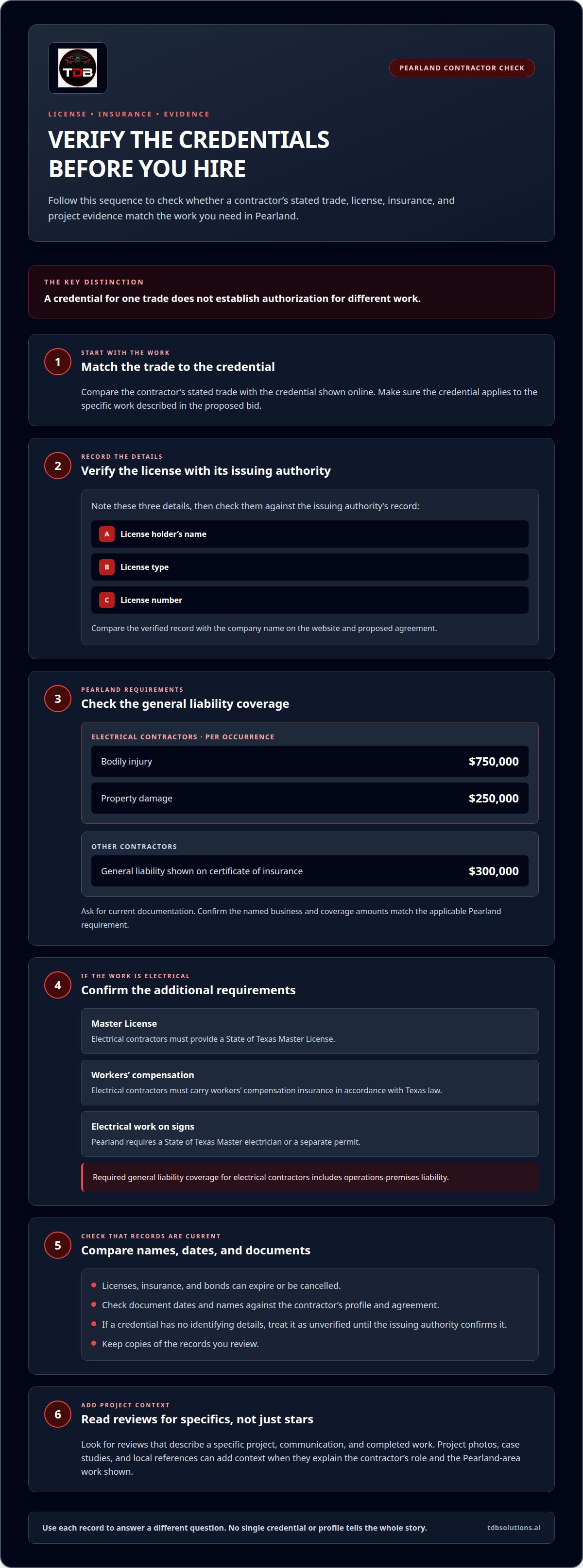
Match the contractor’s stated trade with the credential shown online. Record the license holder’s name, license type, and number, then verify them with the issuing authority. Compare the result with the company name on the website and proposed agreement. A credential for one trade does not establish authorization for different work.
Pearland sets specific insurance requirements. Electrical contractors must carry general liability insurance of at least 750,000 USD per occurrence for bodily injury and 250,000 USD per occurrence for property damage. Other contractors must show at least 300,000 USD in general liability insurance on their certificates of insurance. Ask for current documentation, then confirm the named business and coverage amounts match.
Electrical contractors must provide a State of Texas Master License and carry workers’ compensation insurance in accordance with Texas law. Required general liability coverage for electrical contractors includes operations-premises liability. For electrical work on signs, Pearland requires a State of Texas Master electrician or a separate permit. Match each credential to the work described in the bid.
Reviews and testimonials are most useful when they describe a specific project, communication, and completed work. Read several accounts for meaningful details instead of relying on a star rating or broad praise alone. Project photos, case studies, and local references can add context. Look for a clear explanation of the contractor’s role and the Pearland-area work shown.
Licenses, insurance, and bonds can expire or be cancelled, so verify current records independently. Check the dates and names on documents, and compare them with the contractor’s profile and agreement. If a website displays a credential without identifying details, treat it as unverified until the issuing authority confirms it. Keep copies of the records you review.
Written bids and company contact information
To judge what makes a contractor website look trustworthy in Pearland, compare its company details with the written bid. A clear proposal names the contractor, describes the work, and uses company letterhead. It should include a phone number and address. Check that the business name matches the website and project paperwork. Pearland homeowners should compare three bids to understand differences in scope and materials.
Materials matter. Repair contracts should list the materials the contractor plans to use. Compare product descriptions and note where each material fits the project. If a proposal is vague about materials, it is harder to assess the scope. Request written details before signing so the agreement reflects the work you expect.
A practical test of what makes a contractor website look trustworthy in Pearland is whether its contact information holds up outside the screen. Compare the listed phone number and address with the bid and business profile. Call the number and ask for the person named in the proposal. Confirm the address identifies the business, not just its service area. Consistent details help you identify who stands behind the bid.
Read every document carefully before signing. Do not sign a contract with blank spaces, and keep copies of the agreement and warranty terms. Be wary of a large or full down payment. After a disaster, be cautious about contractors who request payment before work begins. Be cautious about offers involving insurance deductibles, and review the bid carefully before signing.
Check payment and insurance language closely. Avoid agreements that give the contractor all insurance proceeds for listed repairs. Keep the signed bid, contract, and warranty together. Then compare completed work with the written scope. Clear records help resolve questions about agreed tasks, materials, or contact responsibilities.
BBB accreditation status
To assess what makes a contractor website look trustworthy in Pearland, compare its BBB profile with the site’s specific claims. Search the Better Business Bureau by the exact business name and Pearland address. Distinguish accreditation status from ratings, complaint history, and profile details. Each provides different information. A BBB listing alone does not mean the business is accredited.
Businesses do not have to seek BBB accreditation. The BBB requires applicants to agree to its Standards for Trust and pass its vetting process. Look for an explicit accreditation status on the profile. Do not treat a BBB logo, rating, or directory listing as proof of accreditation. This distinction helps you assess what makes a contractor website look trustworthy in Pearland without relying on badges alone.
Read the profile carefully. The BBB does not verify or guarantee the accuracy of information supplied by third parties. Treat profile details as reported information, not independently proven facts. If an address, ownership statement, or service description differs from the website, note the discrepancy. A profile’s presence alone cannot establish who controls the business or website.
The BBB does not endorse businesses, products, or services. Accreditation reflects agreement to standards and completion of the BBB’s vetting process, not a recommendation or guarantee of project quality. A business’s lack of accreditation alone does not establish poor work, since applying is voluntary. Use the profile as one reference alongside other evidence of credentials, completed work, and clear project terms.
AAA Custom Construction is not BBB Accredited. AAA Custom Construction had no complaints filed with BBB in the three years before the profile was viewed. BBB does not currently rate AAA Custom Construction because it does not have sufficient information to issue a rating.
TDB Solutions: Custom Mobile-First Websites
TDB Solutions helps businesses build a clearer online presence through Custom Mobile-First Websites. For a contracting business serving Pearland, a mobile-friendly site with organized service pages and direct contact details gives visitors useful next steps. A well-built website can present work clearly, but it does not replace licensing, insurance, or written project documents.
For businesses serving Pearland, Construction Intelligence and Marketing Media Production can help explain project work through relevant digital content. Construction Intelligence supports clear project information, while content creation and marketing campaigns offer ways to communicate services and completed work. Keep each claim specific, and make sure photos and descriptions reflect the work shown.
Branding & Graphic Design can give your website and marketing materials a consistent visual identity. Aerial photography can add useful views of a property or jobsite, while Real Estate Media supports property-focused visuals. TDB Solutions also provides Aerial Inspections. FAA Part 107 certified pilots perform every flight, with full liability insurance. These services document or present visual information; they don’t independently verify a contractor’s license or business claims.
Choose the service that fits your goal. A mobile-first website can organize service information and contact paths. Marketing Media Production can support clear project storytelling. Construction Intelligence and aerial services can communicate site activity or property details. Based in Houston, TDB Solutions serves Pearland and connects local businesses with these digital and aerial services.
Contact TDB Solutions to discuss the website, media, or aerial services that fit your needs.
Frequently Asked Questions
What website features make a home contractor look trustworthy?
Clear navigation makes information easy to find. Check whether service pages use plain language, explain who each service suits, and distinguish different types of work. A useful page also tells you what information to prepare before discussing a project. For example, a kitchen renovation page can explain whether plans or details about existing conditions would help define the work.
What credentials and licenses should Pearland contractors display on their websites?
Look for credentials that identify the specific trade and the person or business they apply to. A professional association membership, training certificate, and government-issued license are different things. A website should label each accurately instead of grouping them under a vague “certified” claim. That distinction helps you understand whether a credential relates to the contractor’s work or indicates membership or training.
How can customers verify a Pearland contractor's license, insurance, and bonding?
Keep a dated record of the documents you reviewed and the office or organization you contacted. Note the business or individual named in each record, along with the work it covers. This creates a useful reference if project paperwork changes or you need to revisit a credential later. Keep your notes with the signed agreement rather than relying on a website screenshot alone.
What clear pricing, estimates, and payment terms should contractor websites include?
A useful estimate page explains how a request becomes a project-specific proposal. It can tell you what details to submit, such as the type of work, property context, and relevant plans or photos. This sets expectations before you begin. Treat an online estimate request as the start of a scope discussion, not approval of work or a substitute for a written agreement.
What contact information and response times do customers expect from local contractors?
For a productive first message, include the property location, the kind of work you are considering, and a short description of the issue or goal. Attach relevant project documents when appropriate. A clear reply process explains what happens next, such as a discussion, site visit, or written proposal. Do not assume an immediate reply unless the contractor states one.


