

A Facebook Page can help you stay visible to local customers, but it shouldn’t be your only online presence. If you’re asking whether a Facebook Page is enough for a business in Houston in 2026, the practical answer is that it depends on how customers find and evaluate your business. Facebook can support community and repeat engagement; Google search and a clear website help people find key details when they’re ready to compare options or contact you.
It makes sense to value Facebook. It gives you a familiar place to share updates, answer questions, and connect with local customers. But a social profile and a business website do different jobs. Relying on Facebook alone can leave gaps in how customers find your services and decide what to do next.
Here, you’ll learn how Facebook compares with Google search, when a Page can support a local community, and what to do beyond posting so interested customers can take the next step.
Key Takeaways
- Use Google visibility and a clear website to help local customers find your services and decide how to contact you.
- Build community on Facebook with useful, human posts and timely replies to comments and questions.
- Set your Facebook strategy around how customers discover local businesses, not follower count alone.
- Consider whether Facebook’s audience matches the people you want to reach, including older local customers.
1. Google search visibility and customer intent
A Facebook Page can help Houston customers discover your business, but a website gives you more control over how you present it. Facebook supports updates and conversations; your site can bring service details, work examples, and enquiry options together in one place.
Google remains the most popular search engine across mobile and desktop devices. Before reaching out, customers may research a service business and look for reviews, contact details, services, and a website. A Houston customer comparing roof inspectors, for example, needs clear service details and a direct way to enquire, not just a recent Facebook post.
A Houston business can use Google Business Profile if it meets Google’s eligibility criteria. A Facebook Page alone doesn’t establish eligibility. Treat the profile as one way for customers to find your business, and keep its information accurate.
A website is especially useful when customers need to compare services, review past work, or understand where you operate. A contractor serving Pearland and Friendswood can explain project types and coverage in one place. A real estate business can organize property details and photos, while Facebook supports timely updates and local conversations.
Build a basic site around customer questions: what you do, where you work, and how people can reach you. Include service details, examples, and a contact form. Link to the site from Facebook and keep business information consistent across your online profiles. You can also share useful site pages, such as a service explanation or recent project. This gives interested customers a clear path from discovery to the details they need.
Social platforms are designed around content consumption, so a post may introduce your business without giving people everything they need to decide. About one in three consumers now start their search journey on platforms such as TikTok, Instagram, and YouTube. A website gives visitors a place to learn about your services, view your work, read testimonials, and understand what your business offers.
Use your site to show the areas your business serves, its operating history, reviews, and contact details. Keeping these details easy to find can help customers assess whether your business fits their needs and decide how to get in touch.
2. Building and engaging an online community
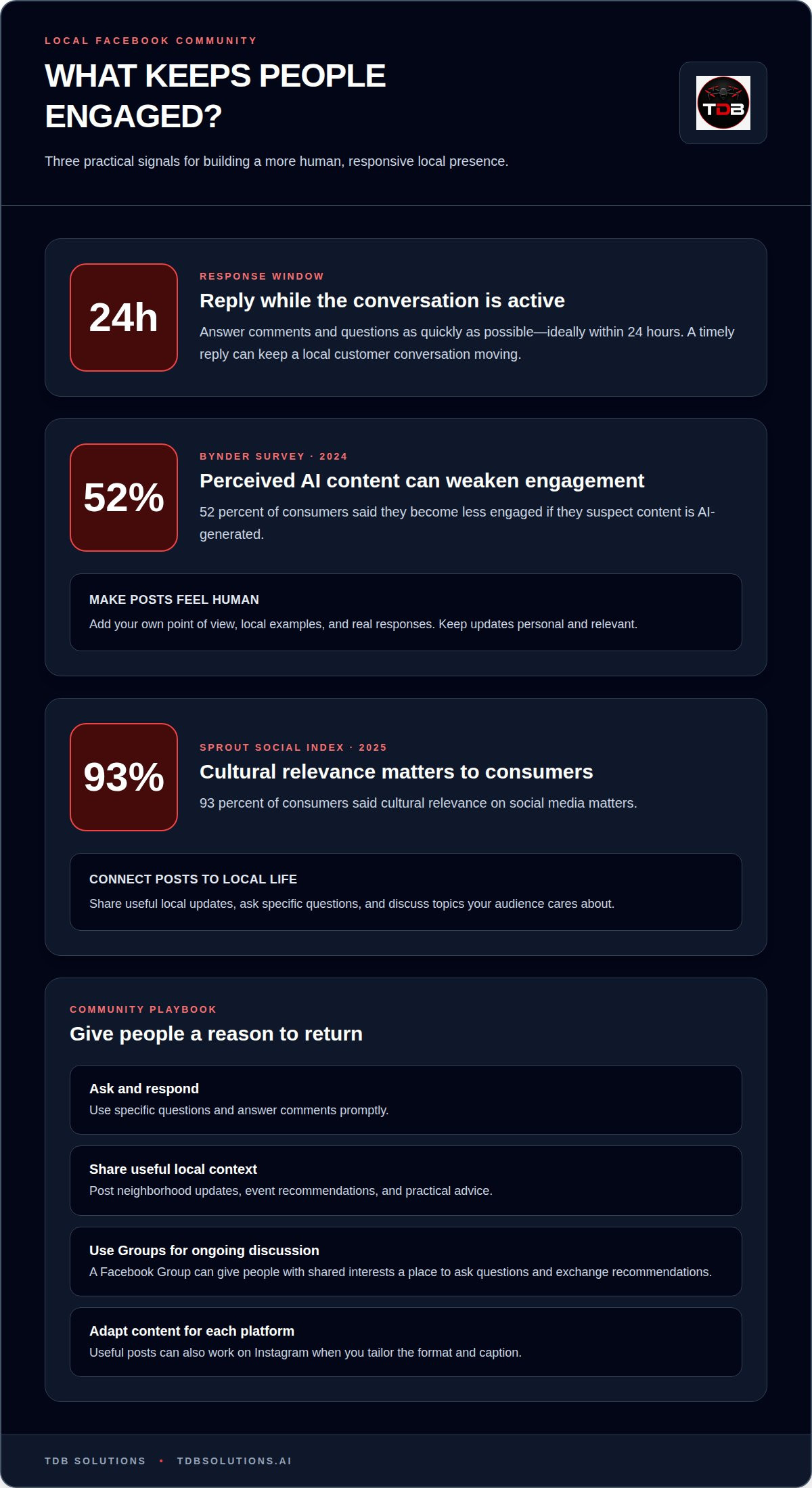
A Facebook Page works best as a place for Houston customers to interact, not just read announcements. Ask specific questions, share useful local updates, and respond to comments promptly. Businesses are advised to answer social media comments and questions as quickly as possible, ideally within 24 hours. A timely reply to a Pearland customer asking about service coverage can keep a conversation moving.
Give people a reason to return. A Houston property business could share a short series showing preparation, photography, and a finished listing. A neighborhood business might invite customers to recommend local events. Videos can also show behind-the-scenes work or discuss topics your audience cares about. Keep posts personal and relevant; generic updates give people little to respond to.
Facebook Groups can support ongoing discussion among people with shared interests. An active Group gives members a place to ask questions, exchange recommendations, and respond to local updates. A business can contribute useful information without turning every conversation into a sales pitch. For example, a League City home-services business could answer a seasonal maintenance question with practical advice.
Make community content feel human. In a 2024 Bynder survey, 52 percent of consumers said they become less engaged if they suspect content is AI-generated. In the 2025 Sprout Social Index, 93 percent of consumers said cultural relevance on social media matters. Add your own point of view, local examples, and real responses. Adapt useful posts for Instagram, but tailor the format and caption to each platform.
A Facebook Page doesn’t determine which licensing, contact, or privacy details belong on your website. Make contact information easy to find, and describe your credentials and data practices accurately.
Consistent visuals can help customers recognize your business across Facebook and Instagram. Branding and graphic design can support that consistency with social media graphics tailored to your business.
3. Facebook strategy for local and community-based businesses
For a local business, Facebook works best as one part of a customer path, not the only channel. A Houston restaurant can post neighborhood updates and menus, while its website holds current details customers can access directly. For an owner asking whether a Facebook Page is enough for a business in Houston in 2026, the deciding factor is whether customers can find the information they need beyond social posts.
As of September 2026, Meta limits most non-paying Facebook business Pages to 2 posts with external links per month. A Facebook Page post with a healthy following might reach 1 to 6 percent of its followers organically. These limits make a link-only strategy fragile. Share useful updates, answer questions, and keep essential business details accessible through another channel.
A Facebook suspension or Page removal can cut off access to posts, messages, and the community gathered there. It can also interrupt a familiar route for customer questions and updates. Keep service details, contact options, and work examples available independently, so customers can still learn about your business if the Page becomes unavailable.
Give each post a clear purpose instead of repeating the same promotion. A Houston contractor could explain a common project question, share a progress update, then invite customers to ask about service coverage. A neighborhood business might post event reminders and follow up with useful details. Different formats give local followers more reasons to engage.
For a community-based business in Galveston or League City, make each Facebook post useful to nearby customers. A contractor could share a project update and explain its service area; an event organizer could post schedule changes and answer attendee questions. Clear information gives people a reason to follow and interact.
Deciding whether a Facebook Page is enough for a business in Houston in 2026 also means considering how you’ll reach customers if the Page is restricted. Use Facebook to encourage local engagement, while keeping core information available through a channel your business controls. That approach lets you benefit from community activity without depending on one account.
4. Facebook’s local and older audience
Facebook can matter when your Houston customers include adults over roughly 40, especially if your business depends on local relationships, repeat visits, or community trust. A neighborhood service company may find Facebook useful for sharing schedule updates and answering familiar questions. Build a separate Facebook content strategy for those customers instead of assuming every platform reaches them in the same way.
Age data offers context, not a Houston-specific forecast. Globally, users aged 55 and over make up close to one-fifth of Facebook users, roughly double their share from a decade ago. That makes Facebook relevant to businesses serving older adults, but your own enquiries and customer conversations should guide what you publish locally.
Make practical information easy to scan. A League City home-services business could post service-area updates, explain what an appointment covers, and provide a clear contact path. A Galveston real estate business could share property details and neighborhood context. Use plain language, readable graphics, and captions that explain why an update matters. These details help customers decide whether your business fits their needs.
Give each post a purpose. Use Facebook for timely announcements, community questions, and customer discussions. Keep essential service descriptions and contact information accessible beyond the feed, so customers can find them after a post moves out of view. Review the questions people ask and the updates that prompt useful conversations. These signals can shape future content without treating follower count as a measure of local demand.
For businesses serving older customers, keep the tone direct and the details consistent across posts. A Friendswood contractor can explain coverage plainly; a local property business can pair neighborhood information with clear listing visuals. Plan property-focused visuals that give Houston-area customers a better sense of a listing and its surroundings.
TDB Solutions
TDB Solutions helps Houston businesses connect social activity with clear information customers can act on. If Facebook brings attention but leaves questions about services, coverage, or next steps, a Custom Mobile-First Website gives customers a direct place to learn more and enquire.
For businesses that rely on strong visuals, Marketing Media Production and Real Estate Media can support content for digital channels. Construction Intelligence and Aerial Inspections serve different needs, helping construction and property teams communicate site or asset information. Choose the next step based on what customers need to understand before contacting you, rather than adding channels without a clear purpose.
Ready to strengthen your business’s online presence? Contact TDB Solutions to discuss your goals.
Build a stronger path from discovery to enquiry
Whether a Facebook Page is enough for a Houston business in 2026 depends on what customers need before they choose you. Use social posts to answer questions and start conversations, then direct interested people to your website for service details and a clear way to enquire. Your posts can bring customers in, while your website helps them understand your work and take the next step.
TDB Solutions offers Custom Mobile-First Websites and Marketing Media Production to help strengthen your online presence. Construction Intelligence supports construction teams with project information, while a clear digital setup helps your business explain its work. Choose support that matches your immediate need, whether that’s a clearer website, stronger content, or better project communication.
Discuss your business goals with TDB Solutions and identify a practical next step. Build from what you already have, then make it easier for Houston customers to find you and take action.
Frequently Asked Questions
Is a Facebook business page enough to establish a business's online presence in 2026?
A Facebook Page can establish a basic presence, but it may not cover every customer need. Someone trying to confirm whether you handle a particular project may need more detail than a short post provides. Treat your Page as one touchpoint, and keep essential information in a format you can organize and update independently. That gives prospects a clearer way to assess your business.
Can a Houston business appear in Google Search and Maps without a website?
Yes. A Houston business can appear through its Google Business Profile without having a website. Keep the profile accurate, including the business name, category, contact details, hours, and service area. For example, a Friendswood contractor can use its profile to help nearby customers find basic business information. A website provides more room for project examples and service explanations, but it isn’t required to have a profile.


