

Raw aerial footage entertains, but structured aerial storytelling is what actually turns casual viewers into paying clients. You already know that publishing dynamic drone content for social media gives your business an immediate visual edge. Still, watching your latest post get scrolled past without generating a single qualified sales inquiry is deeply frustrating.
Cropping wide landscape shots into vertical 9:16 reels often ruins your composition, and navigating FAA Part 107 regulations or Remote ID rules can leave you second-guessing every upload. You shouldn't have to gamble with visual quality or risk federal fines just to market your services online.
In this guide, you'll discover proven aerial video formats and technical production strategies built to hold viewer attention and drive measurable business growth. We'll break down five scroll-stopping visual frameworks for 2026, master the framing rules that boost mobile watch time, and cover the essential compliance steps you need to protect your commercial brand.
Key Takeaways
- Deploying structured drone content for social media creates immediate pattern interruption, stopping fast-scrolling mobile users before they skip past your brand.
- Five repeatable aerial frameworks give contractors, real estate professionals, and retail owners clear visual blueprints that drive engagement instead of passive likes.
- Shooting in high resolution with vertical 9:16 composition and locked-in shutter speeds keeps your mobile reels sharp after platform compression.
- Federal law classifies any promotional business post as commercial airspace use, making FAA Part 107 certification and active Remote ID non-negotiable protections against steep fines.
- Combining high-angle hooks with grounded on-camera messaging creates high-performance video production that guides social viewers directly into your sales pipeline.
Why Drone Content for Social Media Outperforms Ground-Level Video
Every thumb scrolling through a mobile feed runs on autopilot. Standard eye-level smartphone video blends into an endless wall of identical posts, giving viewers zero reason to stop. High-impact drone content for social media acts as deliberate pattern interruption, shattering that monotony by presenting an angle the human eye never sees naturally. High-angle perspectives stop feed fatigue instantly by ripping viewers out of their ground-level reality and forcing an immediate cognitive reset.
There is a massive operational difference between passive scenery and intentional, kinetic motion. A stationary wide shot of an empty lot gets ignored; a disciplined descent that tracks active site machinery commands attention. Commercial brands in competitive metros need high-resolution photos and fluid video to signal technical authority, proving capability before a prospective client even reads the caption.
Breaking the Monotony of Handheld Smartphone Feeds
Handheld mobile clips all look the same. They crop reality into narrow, shaky vignettes that fail to communicate physical scope. Deploying an unmanned aerial vehicle (UAV) solves this by capturing wide establishing views that ground-level devices simply cannot replicate.
For commercial facilities, roofing operations, or real estate assets, elevation communicates scale. A sharp top-down perspective establishes the boundaries of an entire industrial park or coastal acreage in two seconds flat. On fast-moving platforms like Instagram Reels and TikTok, sudden bird's-eye reveals hold attention long enough to turn a casual swipe into an engaged view.
Driving Algorithm Retention Signals with Kinetic Movement
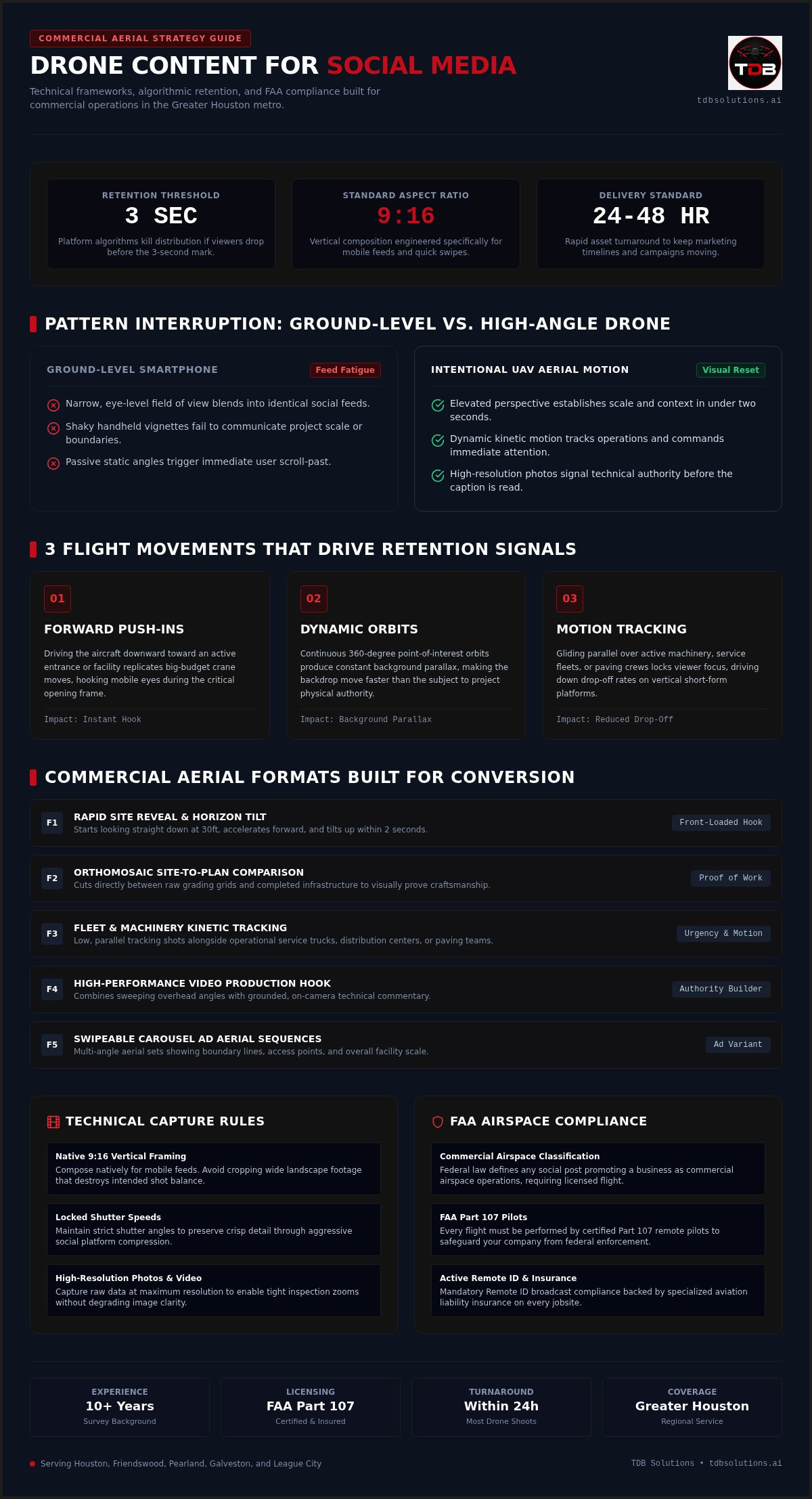
Social media algorithms operate on brutal arithmetic. If your video fails to retain a viewer past the first three seconds, the platform kills its distribution. Platforms reward watch time, completion rates, and immediate rewatches over passive vanity metrics.
- Forward push-ins: Driving the camera downward toward an entrance or active jobsite simulates big-budget crane moves, hooking the eye instantly.
- Dynamic orbits: Circling a commercial building or heavy machinery creates continuous parallax, making the background move faster than the subject.
- Smooth motion tracking: Gliding over site assets locks viewer focus, driving down drop-off rates on vertical short-form platforms.
When you build your drone content for social media around deliberate camera motion, you engineer higher retention directly into the edit. That kinetic energy signals high production value to the platform algorithm, earning your business more organic visibility across your target market.
5 High-Performing Drone Formats Every Business Can Post
Travel vlogs treat flight as eye candy. Commercial operations need their drone content for social media to generate qualified phone calls and signed contracts. Whether you manage commercial developments in Houston or run specialty marine services in Galveston, your aerial video must feature clear text overlays and immediate conversion prompts. These five repeatable formats turn airspace footage into dependable business drivers.
The Rapid Site Reveal and Top-Down Flyover
Start your video looking straight down at the ground from thirty feet up. Within two seconds, push forward at full speed while tilting the camera up to reveal the completed facility, property line, or storefront. That rapid horizon reveal hooks mobile attention immediately.
For industrial roofing and general contractors, pair this move with orthomosaic mapping visuals. Cut directly between a raw construction grid and a completed build. This stark contrast visually proves your craftsmanship before a client even picks up the phone.
The Orbit and Kinetic Action Tracking Shot
Point-of-interest orbits turn ordinary physical assets into cinematic features. Set a tight, continuous 360-degree orbit around your equipment fleet, headquarters, or newest retail buildout. The constant background parallax gives your business substantial physical authority.
Take that motion further by tracking live work. Fly low and parallel alongside a paving crew, a service fleet rolling out of Pearland, or active warehouse logistics. Following dynamic action gives static industrial services an urgent, high-energy presence on mobile feeds. Just ensure your pilot operates strictly under current FAA Part 107 guidelines to keep your commercial channels legally protected.
Carousel Ads and Hyperlapse Progress Sequences
Feed algorithms love multi-slide Carousel Ads because swipe actions count as direct platform engagement. Take four to six aerial frames of a commercial build from the exact same GPS coordinates across different phases. When prospects swipe through the sequence, they watch the building rise from raw dirt to ribbon-cutting.
Compressing time also works wonders in vertical video. A ten-second day-to-night hyperlapse showing traffic flows, warehouse logistics, or retail foot traffic builds instant visual intrigue. If you want to integrate these aerial cuts into a complete client acquisition campaign, explore our guide to marketing video production Houston. When you are ready to produce high-impact assets that set your brand apart, partnering with the media specialists at TDB Solutions ensures every frame delivers measurable business results.
Technical Rules for Capturing Aerial Video for Mobile Feeds
Traditional broadcast standards do not work on vertical smartphone screens. If you simply take a horizontal 16:9 aerial shot and crop it down, you discard over half your sensor data and leave your framing to chance. High-performing drone content for social media requires a mobile-first capture strategy from the moment your aircraft leaves the launch pad.
Locking in pristine mobile playback requires strict adherence to resolution standards. When shooting for Instagram Reels, TikTok, or Facebook feeds, your final export must hit 1080x1920 pixels at a clean 9:16 aspect ratio. Exporting files in MP4 or MOV format using H.264 compression keeps your file sizes well under 500MB, preventing platform algorithms from heavily compressing your footage during upload.
Framing for 9:16 Vertical Video Without Losing Quality
Cropping a standard 4K horizontal clip into vertical orientation reduces your usable resolution down to roughly 1080p, leaving zero room for digital reframing. Flying drones equipped with true vertical gimbal rotation preserves your sensor's entire native resolution. This guarantees your commercial properties and jobsite assets stay tack-sharp on high-density smartphone screens.
Mobile platforms also feature busy interface overlays that ruin poorly planned framing. The bottom third of the display holds video captions, audio tracks, and engagement buttons, while the right margin features share and like counters.
- Enable the 9:16 grid overlay: Keep your horizon lines, building facades, and primary actions centered inside the middle 60% of the viewfinder.
- Protect your margins: Never place business names, project addresses, or graphical callouts near the screen edges where UI icons obscure them.
- Frame wide on location: Leave comfortable vertical buffer space above and below your subject so high-speed motion never clips out of frame.
Shutter Angles, ND Filters, and Smooth Flight Pacing
The unforgiving Texas sun presents immediate exposure hurdles across League City, Friendswood, and the Greater Houston metro. Midday brightness forces automated drone cameras to spike their shutter speeds to 1/2000th of a second. That rapid shutter creates a harsh, hyper-jittery motion cadence that looks cheap on mobile feeds.
Fixing this requires sticking strictly to the 180-degree shutter rule: set your shutter speed to exactly double your frame rate. When shooting at 30 frames per second, your shutter must remain locked at 1/60th of a second. Installing physical neutral density (ND) filters, such as an ND16 or ND64, cuts incoming light and allows you to maintain that ideal shutter speed under harsh coastal glare. Combine this optical balance with slow, measured control stick inputs. Smooth, uninterrupted glides produce natural motion blur, making your drone content for social media look like a dedicated commercial production rather than a casual weekend clip.
FAA Part 107 and Legal Realities of Commercial Social Posts
A persistent myth circulates among small businesses: if you simply post aerial footage to your own Instagram or TikTok page without selling the video file itself, it qualifies as casual recreational flying. That belief is dangerously wrong. The Federal Aviation Administration draws a hard legal line between recreation and commerce. Under federal law, intent dictates classification. If an aerial clip promotes a company, highlights customer work, or aids business development, that flight is strictly commercial.
Publishing drone content for social media without an FAA Part 107 Remote Pilot Certificate exposes your business to federal enforcement actions and crippling liability. When an unlicensed employee or amateur friend crashes into personal property or a bystander while recording a jobsite promo, standard business liability insurance denies coverage instantly. Certified operators carry specialized aviation liability insurance, protecting your corporate assets from costly third-party claims.
The Social Media Business Trap: Hobby vs. Commercial Intent
Federal regulators actively monitor digital platforms. Inquiries frequently begin when competitors report unregistered commercial marketing clips. Any flight conducted to further a business interest, whether for a general contractor in Friendswood or a marine retailer in Galveston, requires a licensed pilot in command.
Every commercial aircraft weighing over 0.55 pounds must also broadcast standard Remote ID telemetry, serving as a digital license plate for local law enforcement and aviation authorities. Cutting corners with unlicensed hobbyist media saves zero money when the FAA issues civil penalties against your business entity.
Airspace Authorizations and Operating Near Populated Areas
Flying across the Greater Houston metro requires navigating some of the busiest airspace corridors in Texas. Filming projects near William P. Hobby Airport or regional facilities in Pearland means you are operating inside controlled Class B, C, or D airspace.
- Automated LAANC clearance: Licensed pilots secure Low Altitude Authorization and Notification Capability clearances directly through FAA systems before launching near flight paths.
- Sustained vehicle flights: Federal rules strictly restrict sustained flight directly over moving traffic on active roadways unless specific aircraft safety requirements are met.
- Open-air assemblies: Filming large crowds at public festivals, retail launches, or outdoor venues demands precise operational planning and compliance waivers.
Professional aerial crews handle flight log audits, airspace authorizations, and safety waivers so your marketing department stays completely clear of regulatory entanglements. To safeguard your brand with fully licensed, legally compliant aerial production, schedule a commercial media consultation with TDB Solutions today.
Turning Aerial Footage Into a High-Converting Social Strategy
Visual spectacle grabs attention, but spectacle alone doesn't close contracts. Aerial video performs at its highest level as the top-of-funnel hook inside a complete customer acquisition system. High-performing drone content for social media stops the scroll within three seconds, buying you the time needed to present your value, build local credibility, and guide qualified viewers directly into your sales pipeline.
Transitioning from social views to signed proposals requires connecting aerial vantage points to real-world operations. When your content pairs overhead scale with clear proof of performance, prospective clients stop seeing a pretty video and start seeing the premier service provider in their market.
Pairing Aerial B-Roll with Mic'd Up Business Storytelling
Flight footage creates curiosity; human voices build trust. A sweeping flyover of an industrial build or commercial renovation captures immediate interest, but cutting directly to a mic'd up business owner explaining how their crew solved a complex site challenge builds instant authority.
This dynamic pacing forms the backbone of High-Performance Video Production. You hook the viewer from the air, anchor their attention with real on-site expertise, and present a clear next step. Direct that engaged traffic off social platforms and push visitors toward dedicated landing pages engineered with mobile-first Houston web design to turn incoming clicks into qualified project inquiries.
Structuring Retargeting Creative and Local Geo-Targeting
Posting once and hoping for incoming calls wastes valuable footage. A profitable distribution plan deploys local Geo-targeting across specific commercial hubs in League City, Friendswood, Pearland, and Katy to deliver your aerial establishing shots directly to target property managers and commercial clients.
- Segment video viewers: Build custom audiences from users who watch at least 50% of your initial aerial flyovers.
- Deploy Retargeting Creative: Re-engage those warm prospects with customer testimonials, detailed project walk-throughs, and specific calls to action.
- Integrate site intelligence: Embed project tracking visuals and interactive updates on your web pages to validate your operational standards.
Working with an integrated media partner removes the operational friction. Experienced teams manage the flight compliance, aerial filming, ground audio, and post-production editing from start to finish, giving your company an authoritative social media pipeline that consistently drives measurable business growth.
Transform Your Feed with High-Impact Aerial Storytelling
Capturing qualified clients on mobile feeds requires more than casual flyovers. High-performing drone content for social media demands deliberate kinetic motion, strict 9:16 vertical composition, and full federal compliance. When you pair dynamic aerial hooks with genuine local storytelling, you stop the scroll and build immediate market authority.
You don't have to navigate airspace clearances, technical camera settings, or complex editing workflows alone. Our team brings over a decade of technical survey and site documentation experience to every flight. Every project is flown by FAA Part 107 certified pilots backed by specialized aviation liability insurance, protecting your company at every step. With turnaround times delivering edited media within 24 to 48 hours of flight, you get speed, legal protection, and pristine quality that drives real business growth.
Partner with TDB Solutions for professional aerial media and social content that sets your brand apart across Greater Houston.
Frequently Asked Questions
Do I need an FAA license to post drone video on my business social media?
Yes, you legally need an FAA Part 107 Remote Pilot Certificate. The FAA regulates commercial intent rather than monetization settings. If you post aerial footage to promote a company, display client projects, or attract bids across Pearland or Houston, federal law classifies the flight as commercial. Flying without a certificate exposes your business to steep civil penalties and voids liability coverage.
Can I shoot vertical video with a standard drone camera?
You can crop horizontal footage in post-production, but dedicated vertical gimbal rotation delivers superior quality. Cropping standard 16:9 4K clips down to 9:16 discards more than half your pixels, creating digital noise on mobile screens. Modern commercial aircraft rotate the sensor mechanically to capture full native resolution. If your camera cannot rotate, keep subjects centered and fly closer to preserve critical detail.
What makes drone video convert better on Instagram Reels and TikTok?
Dynamic aerial movement creates an instant pattern interruption that breaks standard mobile scrolling habits. Most social feeds feature predictable, eye-level video. Elevating the camera reveals operational scale, project boundaries, and architectural scope within two seconds. When you structure drone content for social media with fast motion and pair it with clear calls to action, viewer retention rises and drives traffic directly to your landing pages.
How long should drone clips be for social media marketing?
Individual aerial clips should last between two and four seconds within a larger video edit. Mobile viewers lose focus quickly when watching extended, drifting aerial shots. Use fast-paced establishing reveals to grab attention, then cut directly to ground-level work or on-camera explanations. Keeping your complete short-form video under thirty seconds helps maximize algorithm completion rates on Instagram Reels, TikTok, and YouTube Shorts.
Can drone footage be used for paid social media Carousel Ads?
Yes, aerial imagery works exceptionally well inside multi-card Carousel Ads. Swiping through sequential aerial photography creates strong active engagement signals on platforms like Instagram and Facebook. You can feature project phases from identical GPS coordinates or guide prospects around a commercial facility from varied angles. Each card acts as an individual hook, giving prospective clients multiple visual reasons to request a bid.
What happens if a business hires an uncertified drone pilot for social content?
Hiring an uncertified pilot exposes your business to federal fines and leaves you completely unprotected against property damage or injury claims. The FAA holds companies accountable when they hire unlicensed operators for marketing work. Commercial general liability policies also exclude drone incidents flown by uncertified operators. Certified pilots carry specialized aviation liability insurance and secure legal airspace clearances across League City, Galveston, and metro Houston.
How do high-contrast sunny days affect aerial social video quality?
Harsh midday sunlight causes high shutter speeds, creating jittery, unnatural motion that degrades mobile video playback. Bright skies across the Texas Gulf Coast force automatic cameras to shoot at extreme shutter speeds, eliminating natural motion blur. Installing physical neutral density (ND) filters allows pilots to lock the shutter speed at double the frame rate. This technical balance ensures your drone content for social media stays cinematic, crisp, and smooth.


