
What if your logo looks polished, but your website, social profiles, and printed materials still feel like they belong to different businesses? That disconnect can make it harder for customers to recognize and remember you. Effective brand identity design Houston businesses can apply starts with a clear position, then carries it consistently into every visual and verbal touchpoint.
You may already know your business needs a professional look. The harder decision is what your brand should communicate before you choose colors, fonts, or a logo. A consistent identity isn’t a collection of attractive graphics. It’s a practical system built around your business, your audience, and the impression you want to leave.
This step-by-step guide will help you define your positioning, identify the core parts of a usable brand identity, and apply those choices across your website and marketing content. TDB Solutions provides in-house branding and graphic design, custom mobile-first websites, and marketing media for businesses in Houston, Friendswood, Pearland, Galveston, and League City.
Key Takeaways
- Build brand identity design Houston customers can recognize by connecting your business positioning to a consistent visual and verbal system.
- Define your purpose, audience, customer problem, and point of difference before choosing visual elements.
- Go beyond a logo: align typography, colors, imagery, messaging, and usage guidance to create a consistent brand experience.
- Map your customer touchpoints and keep key brand choices in one source of truth for easier, more consistent application.
- Use a focused project brief to guide graphic design across your website, proposals, social profiles, and printed materials.
What Brand Identity Design Means for a Houston Business
Your brand identity is the visual and verbal system your business uses wherever customers encounter it. It includes what people see, such as your logo, colors, and imagery, as well as your messaging and tone. The idea connects to corporate identity, or the way an organization presents itself to the public. For a Houston-area business, a useful identity creates a consistent impression on a website, social profile, proposal, and printed handout.
Keep three related ideas distinct. Your identity is the system you create and apply. A marketing campaign is a time-limited effort that uses parts of that system to communicate a particular offer or message. Your reputation is what people come to think and say about your business based on their experiences. A consistent identity supports recognition, but it can’t dictate how customers respond or replace reliable service.
What belongs in a brand identity system?
A practical system gives you repeatable choices, not just a finished logo. It can include:
- Visual elements: logo variations, typography, color choices, image direction, and graphic design assets such as social media graphics or flyers.
- Verbal elements: messaging, tone, and language that express how you want to communicate with customers.
- Usage guidance: clear direction for applying those elements across digital and printed materials.
Imagine a Friendswood home-services business. Its website uses a particular typeface and a calm, helpful tone. Its social profiles use the same colors and image style, while its printed estimate carries that look and straightforward messaging. Each piece serves a different purpose without feeling disconnected. That’s the practical value of brand identity design Houston businesses can apply across customer touchpoints.
How is brand identity different from a logo?
A logo is one recognizable asset within the larger identity. It can identify your business, but it can’t set the tone of your writing, make unrelated imagery feel consistent, or determine how your colors and type should appear across materials. Those choices need direction too.
For example, a contractor might place the same logo on every item but use bold industrial colors on the website, unrelated stock photos on social media, and a different type style on proposals. The logo stays the same, but the overall experience doesn’t. A clear identity system connects the pieces through shared colors, typography, imagery, messaging, and usage rules. TDB Solutions provides in-house branding and graphic design to translate a business’s positioning into visual assets for its website and marketing materials.
How to Define Your Houston Brand Before Designing Visuals
Start with decisions, not colors. A clear brand foundation gives you a reason for each design choice and helps you avoid generic claims like “great service” that could describe almost any business. Use this process to define what your identity needs to communicate before you begin visual design.
How do you identify your audience and difference?
Look beyond broad demographics. Describe the people or organizations you serve by what they need, what they’re trying to accomplish, and what they value in a working relationship. Review real customer questions, common requests, and the steps you take to deliver your service. These details provide stronger direction than assumptions.
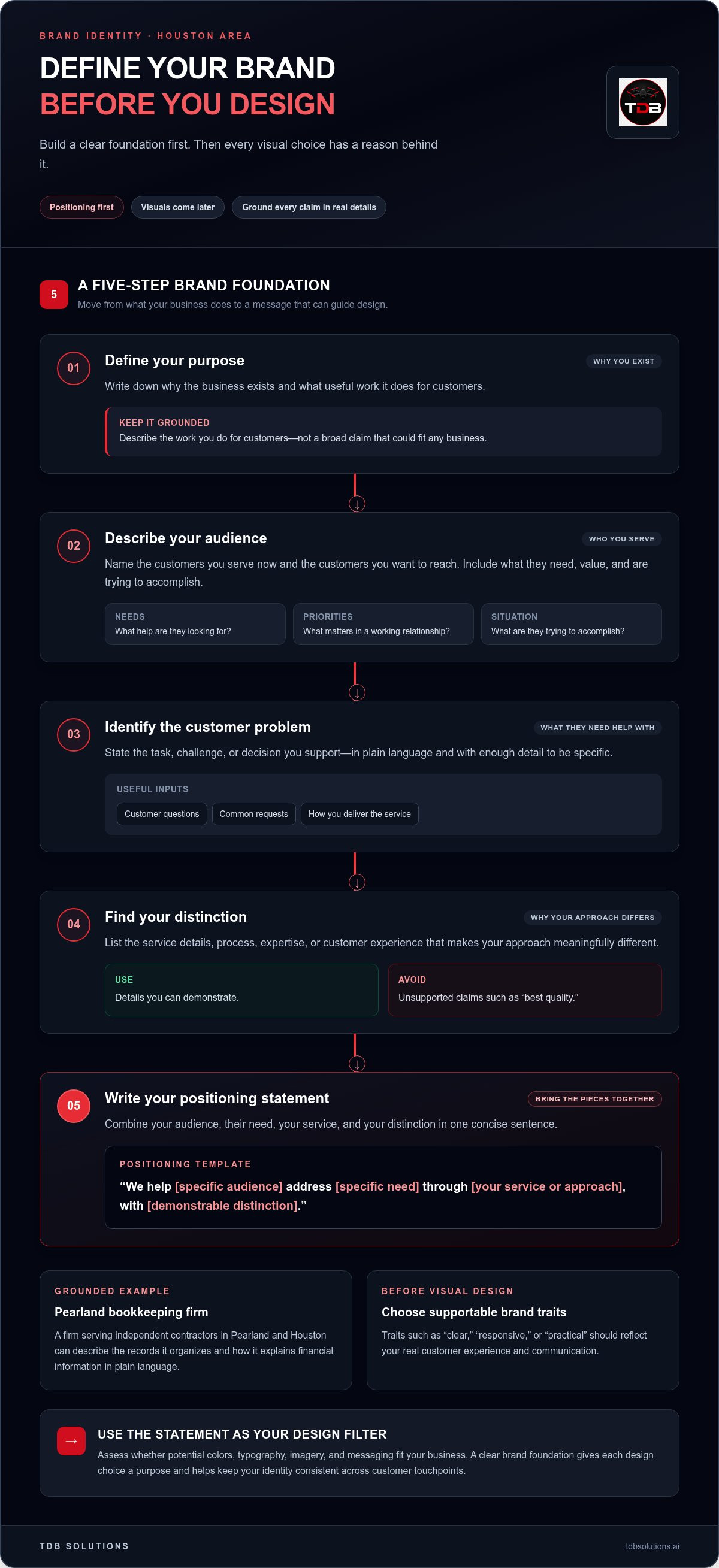
- Define your purpose. Write down why the business exists and what useful work it does for customers.
- Describe your audience. Name the customers you serve now and the customers you want to reach. Include their needs, priorities, and situations.
- Identify the problem. State what customers need help with in plain language. Be specific about the task, challenge, or decision you support.
- Find your distinction. List the service details, process, expertise, or customer experience that makes your approach meaningfully different. Use details you can demonstrate, not claims like “best quality.”
- Write a positioning statement. Combine your audience, their need, your service, and your distinction in one concise sentence.
For example, imagine a Pearland bookkeeping firm serving independent contractors in Pearland and Houston. Rather than claiming to be “trusted and professional,” it might describe the records it organizes and how it explains financial information in plain language. The point is to state a real difference, not promise a particular outcome.
What brand message should guide the design?
Choose a few traits your business can support through its actual customer experience. “Clear,” “responsive,” or “practical” can guide design only if your communication and service reflect those qualities. Write a short core message before collecting visual references. For brand identity design Houston businesses can use consistently, the message should fit your real services and intended customers, whether they’re in Houston, Friendswood, Pearland, Galveston, or League City.
Try this positioning template: “We help [specific audience] address [specific need] through [your service or approach], with [demonstrable distinction].” Keep it focused. Use the statement to assess whether potential colors, type, imagery, and messaging fit your business. TDB Solutions provides branding and graphic design support to turn that direction into visual materials.
Why Houston Brand Identity Design Is More Than a Logo
A polished logo can identify your business, but it can’t make every customer touchpoint feel connected on its own. If your website uses one visual style, your social posts another, and your marketing materials a third, the logo has to carry the whole identity. That’s too much work for one asset. Effective brand identity design Houston businesses can apply pairs a logo with clear choices for typography, color, imagery, messaging, and how each element appears.
What can a logo do, and what can’t it do alone?
A logo gives customers a visual marker to associate with your business when they see it in context. It can appear on your website, social profiles, proposals, or printed pieces. But it doesn’t decide which photos fit your message, how a page should be organized, or whether your writing sounds direct, warm, or technical. A logo redesign alone can’t promise recognition, leads, or sales.
Think of a Houston-area service business with a clean, modern logo. If its website uses formal language, social posts use playful graphics, and printed materials use unrelated colors, customers encounter mixed signals. The logo may remain consistent while the rest of the experience feels disconnected.
How do consistent visual choices work together?
A brand system gives each design choice a shared direction. Typography sets the tone and helps organize information. Colors create a repeatable visual pattern. Imagery supports the business’s positioning, while graphic design assets such as icons or social graphics extend that look. Messaging ties the visuals to what you actually do.
For example, a Houston contractor could use the same headline type, color palette, and straightforward language on its website and social posts. The website might use those choices in service headings and project descriptions; a social post could apply them to a project update. The formats differ, but the visual logic stays the same.
A short style guide makes those decisions easier to repeat. Keep it practical: include approved logo files, color values, font choices, image direction, and a few examples of how to apply them. Give employees and designers a clear reference so they don’t have to rely on memory or guesswork.
| Customer touchpoint | Logo-only approach | Connected identity system |
|---|---|---|
| Website | Logo appears, but type, colors, images, and tone vary. | Logo, page styles, imagery, and messaging follow shared guidance. |
| Marketing material | A flyer or social post uses unrelated fonts and graphics. | The format changes, but the visual and verbal choices stay aligned. |
How to Apply and Refine Your Brand Identity Across Customer Touchpoints
A brand identity works as a system when you apply it wherever customers meet your business. Start by mapping those places. Include your website, social profiles, proposals, email materials, and printed pieces such as flyers or brochures. Focus on the touchpoints customers actually use, rather than every format you might create someday.
Your website often brings several identity elements together: logo, color, type, imagery, and core messaging. Check that these choices carry through the page layout and remain easy to read on mobile screens. For practical guidance on adapting a site for smaller screens, read our Houston mobile-first web design guide.
How can you check whether the identity feels consistent?
Put a few real customer-facing materials side by side, such as a website page, a recent social post, a proposal, and a printed handout. Compare them against the positioning you defined before design began. Ask whether each piece communicates the same business and whether any visual or verbal choice sends a conflicting signal.
- Color and type: Do the same color choices and type styles appear, or do they change without a clear reason?
- Imagery and messaging: Do photos, graphics, and wording reflect your intended audience and business position?
- Legibility: Can customers read key information on a phone screen and in print? Does the logo remain clear at the size and format where it appears?
Keep one source of truth for approved logo files, color values, type choices, image direction, and usage guidance. A shared folder or simple style document can serve this purpose. Direct anyone creating materials to the same reference, so they don’t rely on old files or personal guesses.
When should you update a brand identity?
Consider an update when your identity no longer reflects your business, services, or intended audience. Start by naming the specific problem. Maybe colors vary across materials, the imagery no longer fits your work, or your messaging describes an earlier version of the business. A focused correction may address that gap; a full redesign makes sense when the identity itself needs a broader reset.
Don’t change direction just because a visual trend has shifted. For brand identity design Houston businesses can maintain over time, prioritize choices that fit your positioning and work across your real customer touchpoints. If your website needs to carry that identity more clearly, explore branding and website design from TDB Solutions.
Build a Practical Houston Brand Identity with Graphic Design Support
A focused brief turns brand decisions into clear design direction. Before starting, gather materials that show how customers currently experience your business. This gives you and your design team something concrete to assess instead of relying on memory or broad impressions.
What should you prepare before a brand identity project?
Collect your current logo files, key website pages, social profiles, proposals, and printed marketing materials. Then write a short brief covering:
- Business purpose: What does your business do for customers?
- Audience: Who do you serve, and what do they need?
- Key services: Which services should the identity help people understand?
- Distinctive strengths: What can you point to that sets your approach apart?
- Core message: What should customers understand about your business?
- Current touchpoints: Where do customers encounter your brand today?
Finish by naming the inconsistencies that matter most. For example, your website may describe your services clearly while your social graphics use a different tone and visual style. Identify which materials are affected and what you want them to communicate instead. This keeps the project grounded in real business needs.
How can graphic design support a consistent brand?
Once you establish the positioning, graphic design translates it into usable assets. TDB Solutions provides in-house branding and graphic design for materials such as logos, social graphics, and flyers, then carries those design choices into website and marketing content. The company also provides custom mobile-first websites and marketing media production. Each piece can follow the same brand direction while serving a different purpose.
For a Houston business, a custom mobile-first website can present your services and messaging across screen sizes. Marketing media can extend the same visual and verbal identity into content customers encounter elsewhere. The aim is alignment, not a promise of a specific business result. For more local context, read our Houston business branding guide.
Bring your brief and current materials together, then use them to guide brand identity design Houston customers will encounter across your touchpoints. Talk with TDB Solutions about brand identity design.
Give Your Brand a Clear, Consistent Direction
A lasting identity starts with what your business stands for, who you serve, and what makes your approach distinct. Turn that foundation into more than a logo: choose visual and verbal elements that work together across your website, social profiles, proposals, and printed materials.
Then check those touchpoints side by side. A shared reference for your logo, colors, typography, imagery, and messaging helps keep future materials aligned. That’s the practical value of brand identity design Houston businesses can build on as their services and communications evolve.
TDB Solutions is based in Friendswood, Texas, and supports Houston-area businesses with in-house graphic design, branding, custom mobile-first websites, and marketing media production. If you’re ready to shape a clearer identity and carry it through your customer touchpoints, talk with TDB Solutions about your brand identity.
Start with a clear direction. The right design choices can help your business present itself with consistency and confidence.
Frequently Asked Questions
What is included in a brand identity design?
A brand identity design includes the visual and verbal elements your business uses across customer touchpoints. It may include a logo, typography, color palette, image direction, messaging, supporting graphic design assets, and usage guidance. A practical brand identity design Houston businesses can apply should connect those choices to the company’s position and audience. That gives you a shared reference for your website, social profiles, proposals, and printed materials.
How do I create a brand identity for my small business?
Start by defining your business purpose, intended customers, the problem you solve, and what distinguishes your approach. Use real service details rather than broad claims like “high quality.” Then write a concise positioning statement and choose visual and verbal elements that support it. Review how those choices will appear across your actual customer touchpoints before creating or updating design assets.
Is brand identity design just logo design?
No. A logo is one element of a brand identity, not the full system. Your identity also guides typography, colors, imagery, messaging, and how those parts work together. A logo can identify your business, but it can’t make a website, social post, and proposal feel consistent by itself. Clear design guidance helps you apply the same direction across those materials.
How do I make my business brand look consistent across platforms?
Set up one source of truth for your approved logo files, color choices, fonts, image direction, and messaging guidance. Then compare real materials, such as a website page, social profile, proposal, and printed handout. Check for conflicting visuals or tone, and confirm that key information stays legible on mobile screens and in print. Update inconsistencies using the same brand reference.
Can a small Houston business build a brand identity before redesigning its website?
Yes. Define your audience, positioning, message, and visual direction before a website redesign. Those decisions give the site a clearer foundation and can guide your marketing materials too. A small business in Houston, Friendswood, Pearland, Galveston, or League City can start by reviewing its current customer touchpoints and identifying what the new identity should communicate. You don’t need to begin with a website rebuild.
When should a business update its brand identity?
Update your brand identity when it no longer reflects your business, services, or intended audience. First identify the specific issue: perhaps your imagery feels disconnected, your materials use inconsistent colors, or your message describes an earlier version of the company. A focused adjustment may solve a limited problem. Consider a larger redesign when the underlying identity no longer fits, not simply because a trend has changed.
What should I prepare before working with a graphic designer on my brand?
Gather your current logo files, website pages, social profiles, proposals, and printed marketing materials. Write down your business purpose, intended customers, key services, distinctive strengths, and the message you want customers to remember. Note which materials feel inconsistent and where customers encounter them. This gives your designer practical context for translating your positioning into graphic design assets that fit your business.


