
A clean finish can hide a costly quality gap. In Pearland, the financial risk of poor quality control in construction can build quietly: work gets covered, crews move on, and a deviation surfaces only after it disrupts the schedule. The financial risk of poor quality control in construction Pearland teams face can grow when records are missing or inconsistent, making it harder to establish when a change began.
Rework affects more than the work itself. It can require additional labor and materials, change the sequence of tasks, leave crews waiting, and complicate project decisions. Catching and documenting visible differences early gives your team clearer information to review, though it cannot prevent every quality issue.
This article explains how quality gaps can affect project finances and compares practical ways to identify and document site changes. You’ll learn how regular aerial documentation, orthomosaics, and site-to-plan comparison can support oversight in Pearland. These records add dated views of site conditions, helping you review visible changes alongside inspections, approvals, and other project controls.
Key Takeaways
- See how missed or undocumented quality deviations can lead to rework, schedule changes, and financial uncertainty on Pearland projects.
- Understand the financial risk of poor quality control in construction Pearland teams can face when issues surface after work is covered or completed.
- Compare field inspections, routine photo records, and aerial progress documentation to match evidence methods with project questions.
- Build a practical review process: set checkpoints, capture site conditions, log issues, assign follow-up, and retain records.
- Learn how aerial documentation, orthomosaics, and site-to-plan comparison can add visibility to project oversight without replacing inspections or professional judgment.
How Poor Quality Control Creates Financial Risk on Pearland Construction Projects
You’re balancing budget, schedule, and completed work on a Pearland jobsite. A quality gap can put pressure on all three, especially when a deviation goes unnoticed until other work depends on it. The financial risk of poor quality control in construction Pearland teams face depends on the project and the issue. Missed, undocumented, or unresolved departures from project requirements can create avoidable financial exposure.
Construction quality-control financial risk is the potential financial impact of defects or departures from project requirements, including rework, schedule disruption, claims, and delayed decisions. Quality control helps teams check work against requirements and identify items for review. For a high-level overview, see Quality control principles.
What financial exposure can a quality failure create?
Rework uses labor and materials that the team planned for other tasks. It also takes management attention: someone must document the issue, coordinate a response, and adjust the work plan. If the problem appears after crews complete dependent work, the team may need to revisit sequencing. That can disrupt handoffs, delay follow-on tasks, or leave crews waiting for direction.
Records matter, too. If photos, inspection notes, and issue logs don’t show what the team observed and when, people may have trouble establishing how a deviation developed or who addressed it. That can complicate claim discussions and slow decisions. These effects are possible, not automatic. The impact depends on the work involved, the project schedule, and the records available.
Why early visibility matters on a Pearland jobsite
Visible deviations are easier to review while the relevant work remains accessible. A timely observation lets the team compare site conditions with project requirements, record what it sees, and decide what needs follow-up before work progresses. It does not guarantee that every defect will be found or prevent every schedule change. It gives decision-makers clearer information while they consider next steps.
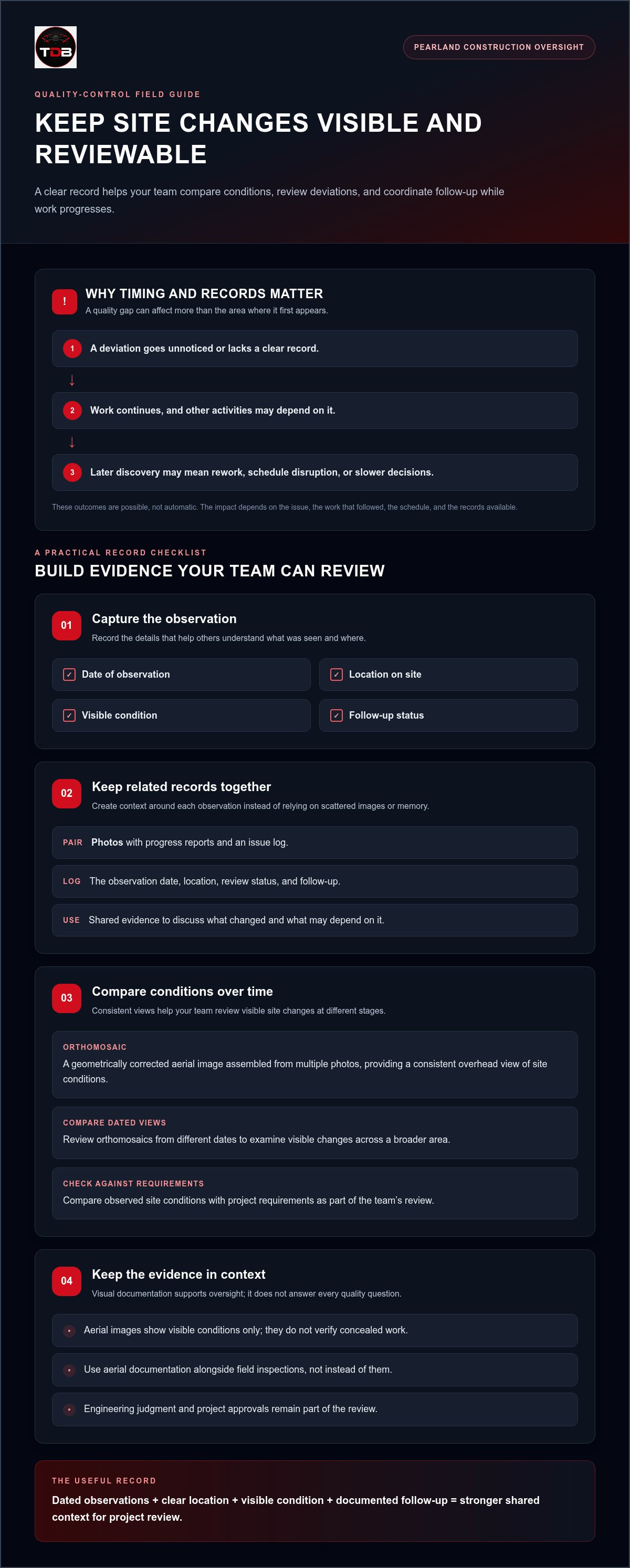
For Pearland project oversight, organize evidence around useful review points. Record the date, location, visible condition, and follow-up status. Consistent records help your team compare site conditions over time instead of relying on scattered images or memory. Construction intelligence drone data can add regular aerial views to that record and help your team review overall site progress. Aerial documentation supplements field inspections and professional judgment, it does not replace them.
How Quality Issues Grow into Financial Problems During Construction
A quality issue can affect more than the area where it first appears. The sequence often starts with a deviation that goes unnoticed or lacks a clear record. Work continues, other activities rely on it, and the team may discover the issue only after the site has moved on. To understand the financial risk of poor quality control in construction Pearland projects face, track how an early quality gap can lead to rework, schedule changes, and uncertainty.
From missed deviation to rework and schedule pressure
Consider a hypothetical Pearland project where an installed component doesn’t match the project requirements. If the team spots the difference while the work remains accessible, it can assess that area and determine what action is appropriate. If later work conceals it, the team may need to expose or remove completed work before making a correction. Any effect on dependent activities is a separate concern: follow-on work may need to wait or change sequence while the team reviews the issue.
The later a team finds a deviation, the more completed or dependent work may need review, increasing the potential for rework and schedule disruption. This chain is possible, not inevitable. The financial impact depends on the location and nature of the issue, what work has followed, the project schedule, and the decisions the team makes.
How documentation supports better decisions
Dated, consistent records help your team compare the site at different stages. Pair photos with progress reports and an issue log that identifies the location, observation date, review status, and follow-up. That context can help the team investigate when a visible change first appeared, identify work that may depend on it, and discuss next steps using shared evidence rather than memory alone.
An orthomosaic, a geometrically corrected aerial image assembled from multiple photos, can provide a consistent overhead visual record of site conditions. Comparing orthomosaics from different dates can help teams review visible changes across a broader area. Aerial images show visible conditions only. They don’t verify concealed work or replace field inspections, engineering judgment, or project approvals.
Quality and safety standards also depend on coordination across the building sector. The National Institute of Building Sciences describes a consultative council that brings government and industry perspectives together. Project teams can apply that practical focus by keeping review criteria and records clear for everyone involved.
For added site context, explore construction intelligence and aerial progress documentation. Consistent visual records can support your review process, while your project team determines what findings mean and what action to take.
Compare Construction Quality-Control Methods for Pearland Projects
You need evidence that answers specific questions. A field inspection gives direct, context-sensitive review. Routine photos preserve selected views. Aerial progress documentation adds a wider look at visible site conditions. For Pearland projects, these methods work best as complementary records, not substitutes for one another. Choose the mix based on the work, review needs, and decisions your team must make.
What each documentation method can and cannot show
Field inspections let qualified project personnel examine work directly, consider surrounding conditions, and follow up on observations. Routine ground-level photos can capture details at a selected location, but inconsistent timing, angles, or labels can make comparisons harder. Aerial photography can show broader visible conditions, such as site access, staging areas, and overall progress, but it may not capture close-up details.
Aerial documentation records visible site conditions; it does not approve work. An image or map cannot establish whether concealed work meets project requirements. Use visual records to inform review, not to replace inspections, technical judgment, or required approvals.
| Method | Visibility | Record consistency | Useful project question |
|---|---|---|---|
| Field inspection | Direct review of accessible work and surrounding context | Depends on consistent notes and inspection records | What needs closer examination at this location? |
| Routine photo records | Specific details from selected ground-level viewpoints | Improves when teams keep dates, locations, and angles consistent | How did this visible detail change between visits? |
| Aerial progress documentation | Broader view of visible site conditions and progress | Repeat views can support comparison over time | Where has visible site activity or layout changed? |
When aerial records add useful project context
Repeat aerial views help you compare visible progress from one documented date to another. An orthomosaic combines multiple aerial photos into a geometrically corrected image, giving teams a consistent overhead view for reviewing site conditions. A site-to-plan comparison overlays drone-generated mapping with design plans to flag apparent differences for further review. It can direct attention to an area, but it does not determine whether a deviation is acceptable.
Building information modeling can provide another reference point. Autodesk Revit is a BIM tool used to design and manage building information models. Its relevance depends on the project’s workflow. Don’t assume aerial records automatically integrate with a Revit model.
To assess the financial risk of poor quality control in construction Pearland projects may face, match the evidence to the question: inspect work directly, photograph details consistently, and add aerial views when broader site context helps. Used together, these records give your team different perspectives for informed review without asking any one method to prove more than it can.
A Practical Pearland Quality-Control Process to Limit Financial Exposure
A clear process gives your team a shared way to spot, record, and review site conditions. It won’t eliminate every quality issue. It can help you make decisions with better context and keep observations from getting lost between site visits.
Set review points and keep a consistent record
Work with your project team to choose review points that fit the work and project sequence. Tie them to meaningful milestones, such as before an area becomes difficult to access or when visible progress needs comparison with current project information. Set timing around the project’s actual needs rather than assuming one schedule fits every site.
At each review, capture enough detail for someone else to understand the record later:
- Date and location: Identify when and where the team observed the condition.
- Visible condition: Describe what the record shows without labeling it a defect before review.
- Follow-up status: Note whether the observation needs review, has an assigned next step, or has been resolved.
- Reference material: Connect the record to the relevant current plan or project information, when available.
Use consistent file names and shared storage so your team can retrieve records by date, location, or issue. For example, a file name can include the project area and capture date, while the issue log records the observation and follow-up separately. Repeated aerial documentation can add a broader view of visible site progress to progress reports and overhead oversight. The goal is an orderly record, not a guarantee that the team will catch every deviation.
Turn observations into assigned follow-up
An observation prompts review, it is not automatically a confirmed defect or formal nonconformance. Record what you can see, then route the item to the person responsible for evaluating it against current plans and approved project information. Keeping that distinction clear makes the record factual while the appropriate project team determines what the observation means.
Assign a clear next step and track its status. Follow-up might call for a closer field review, a comparison with a plan, or a decision from the responsible project personnel. Add the result to the record so the team can see how the observation moved from identification to resolution, or why it remains open.
This sequence can help Pearland project teams examine the financial risk of poor quality control in construction Pearland projects may face: define review points, capture conditions, log observations, assign follow-up, and retain records. Each step supports a practical decision without promising to remove uncertainty or replace professional judgment.
For regular aerial documentation to support site progress reports and overhead oversight, explore construction intelligence services.
How TDB Solutions Supports Construction Oversight in Pearland
For a Pearland project team, aerial progress tracking adds another view of visible site conditions. TDB Solutions provides construction intelligence and aerial documentation in Pearland and the greater Houston area. FAA Part 107 certified pilots capture project imagery, and founder Dillon Bates brings more than 10 years of survey experience to the work. That background informs how the team documents sites, while aerial records remain a support for oversight, not a substitute for field inspections, technical judgment, or project approvals.
What aerial construction intelligence can contribute
High-resolution photos help you review visible progress across a site. Repeated documentation creates a dated timeline of observable conditions, so your team can compare site activity and changes over time. Depending on project needs, TDB Solutions provides regular aerial documentation, site progress reports, volumetric measurements, and overhead oversight.
These deliverables help answer practical questions: What visible work has progressed since the previous record? Where has site activity changed? Which area may need a closer look from the project team? An orthomosaic gives you a consistent overhead view, while a site-to-plan comparison can identify apparent differences for further review. Neither confirms concealed conditions or determines whether work meets project requirements. Aerial data supports your team’s review. It doesn’t approve work or guarantee defect detection, financial savings, or delay prevention.
A clear next step for a Pearland project team
Before setting up documentation, identify the project area you want to track, the oversight question you need to answer, and the reporting cadence that would help your team review progress. You might need repeat views of a specific work zone or broader overhead context for progress updates. TDB Solutions tailors aerial documentation to project needs, giving your team a defined visual record to use alongside its other review processes.
Better visibility can support more informed decisions about the financial risk of poor quality control in construction Pearland projects may face. It won’t remove project uncertainty, but clear records can help your team discuss visible changes with shared context. Discuss construction intelligence for your project and outline the site area, oversight question, and reporting cadence that matter to your team.
Build Clearer Oversight Into Your Next Project
Quality gaps can lead to rework, schedule disruption, and difficult decisions, especially when teams lack consistent records. The financial risk of poor quality control in construction Pearland projects face depends on the issue and project conditions, but early visibility and organized evidence can help your team assess changes with better context.
Use field inspections, dated photo records, and aerial progress documentation for different purposes. Set review points, record visible conditions, assign follow-up, and retain the information your team needs to compare site progress over time. These steps support informed oversight, though they can’t guarantee that every issue will be found or prevent every delay.
TDB Solutions serves Pearland and the greater Houston area, including Houston, Friendswood, Galveston, and League City. FAA Part 107 certified pilots capture aerial records, backed by founder Dillon Bates’s more than 10 years of survey experience. Aerial documentation supports project review; it doesn’t replace inspections or approvals.
Discuss construction intelligence for your project and identify the site area, oversight questions, and reporting cadence that fit your needs. With a clearer record, your team can review visible progress with more useful context.
Frequently Asked Questions
How does poor quality control create financial risk in construction?
Poor quality control can create financial exposure when a missed, undocumented, or unresolved departure requires rework, disrupts dependent activities, or delays decisions. For Pearland teams, the financial risk of poor quality control in construction Pearland projects face depends on the issue, schedule, work already completed, and records available. Dated photos, clear issue logs, and assigned follow-up help teams assess conditions and discuss next steps.
Can construction quality control prevent every project loss?
No. Consistent quality-control practices can help teams identify and document concerns, but they can’t prevent every defect, delay, dispute, or financial loss. Project outcomes depend on the issue, the work involved, and the decisions made as the project progresses. Use quality reviews to support timely decisions, and keep records that show what the team observed, when it was observed, and how it handled follow-up.
How can aerial documentation help with construction quality control?
Aerial documentation adds dated views of visible site conditions, helping your team review progress across a wider area and compare conditions over time. Orthomosaics can provide a consistent overhead image, while site-to-plan comparison can flag apparent differences for further review. TDB Solutions provides construction intelligence in the Houston area, including Pearland, with flights performed by FAA Part 107 certified pilots. Aerial records support oversight, not work approval.
What is the difference between construction inspection and aerial progress documentation?
A construction inspection involves direct review of work by the responsible project personnel, who can assess details and context. Aerial progress documentation records visible site conditions from above and can help teams track broader changes over time. The methods serve different purposes and can complement one another. Aerial images don’t confirm concealed conditions, replace inspections, or determine whether work meets project requirements.
When should a construction team document a quality concern?
Record a concern when you observe it, while the location and visible condition remain clear. Note the date, specific area, what you observed, and any follow-up status. Keep the observation separate from a confirmed defect or formal nonconformance until the appropriate project team reviews it against current plans and approved information. Clear, timely documentation gives the team useful context for investigation and decisions.
Can a drone identify every construction defect on a Pearland jobsite?
No. A drone records visible conditions from its flight perspective, but it can’t identify every defect or verify work that’s concealed or outside the imagery. Aerial photos may help your team spot visible changes or areas that need closer review. Use them alongside field inspections and professional judgment. TDB Solutions serves Pearland and the greater Houston area with aerial documentation to support, not replace, project oversight.
How can Pearland builders compare construction progress with project plans?
Builders can review dated site records alongside current project plans to check whether visible conditions appear consistent with planned work. A site-to-plan comparison overlays drone-generated mapping with design plans to help identify apparent deviations for further review. An orthomosaic can provide a consistent overhead view for that discussion. These visual tools don’t certify compliance or replace inspections, technical judgment, or project approvals.


