

A contractor website should fit the way your business works and help homeowners understand your services. The right site depends on the pages, content, design, and features needed to present your work clearly and guide visitors toward an inquiry.
Look beyond appearance. A professional site should help potential customers understand your work, view relevant project photos, and contact you from a phone or computer. Clear service information and an easy-to-find contact option make the site useful.
This guide covers the core pages contractors should consider, the features a website can include, and the ongoing tasks that keep a site available and secure. Content, mobile performance, and project media all help you plan a site for your business in Galveston.
Key Takeaways
- Website scope varies by build path, design needs, page count, and content. Knowing these factors helps you compare what a project covers.
- Strong core pages make it easier for potential customers to understand your services, review your work, and get in touch.
- Mobile-first design, clear inquiry forms, and relevant project media can help your website serve visitors more effectively.
- Hosting, domain management, maintenance, and security are ongoing parts of website ownership, not just launch tasks.
Contractor website build options
Your build approach determines who handles design, content, and launch tasks. Choose an arrangement that matches your business needs and the support you expect.
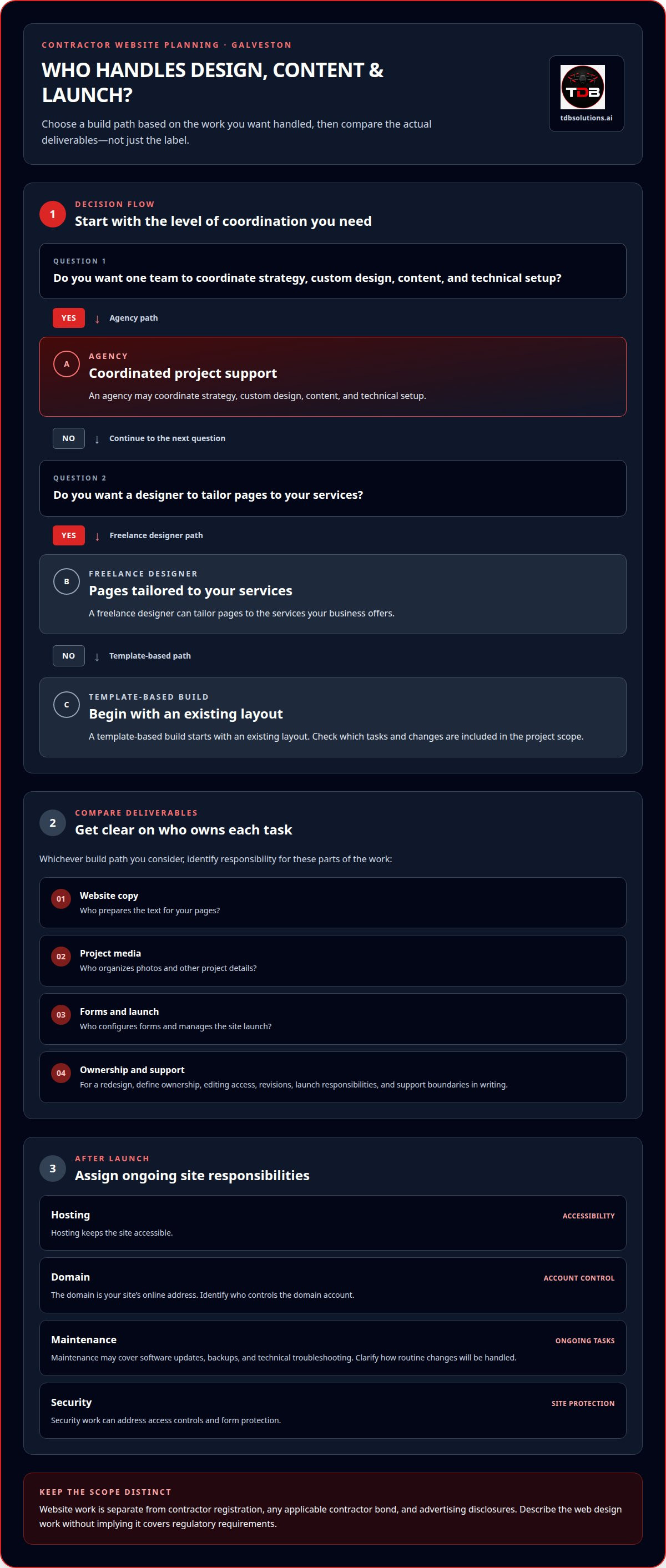
A template-based build starts with an existing layout, while a freelance designer can tailor pages to your services. An agency may coordinate strategy, custom design, content, and technical setup. Compare deliverables rather than labels: identify who prepares copy, organizes project media, configures forms, and manages the site launch.
Keep website scope separate from contractor registration requirements. The City of Galveston requires contractors registering with it to register. Registration and any applicable contractor bond are separate from website work, not website deliverables.
Local SEO and Google Business Profile work can include location-focused page content, profile updates, and business information management. Define the tasks and intended service areas in the project scope. Website licensing, contractor registration, and advertising disclosures are distinct matters, so the web design agreement should describe its work without implying it covers regulatory requirements.
Hosting, Domain, Maintenance, and Security
Hosting keeps a site accessible, while the domain is its online address. Maintenance may cover software updates, backups, and technical troubleshooting; security work can address access controls and form protection. Assign responsibility for each task, identify who controls the domain account, and clarify how routine changes will be handled after launch.
Redesign and Designer Selection
A redesign may involve new page layouts, updated branding, content migration, or a technical rebuild. Ongoing updates can include changing service information or adding project details. Before selecting a designer, review contractor-focused work and define ownership, editing access, revision steps, launch responsibilities, and support boundaries in writing. A clear scope helps you understand what the designer will deliver and who handles each task.
Core website pages
A contractor website needs clear routes from a homeowner’s first visit to a useful inquiry. The homepage should identify your trade, service area, and primary next step. A Galveston homeowner looking for roofing work should understand what you do without searching through unrelated project details.
Build service pages around the work you want to book. A general contractor might give remodeling, roofing, and exterior repairs their own focused pages. Each page can explain the service, show relevant project photos, describe the service area, and invite visitors to submit an inquiry. Specific pages also let you answer practical questions before a customer calls.
- Projects: Pair completed-work photos with concise descriptions of the job and services performed.
- About: Introduce the business, team, and experience in language homeowners can quickly understand.
- Service areas: Name the communities you serve, such as Galveston, Friendswood, or League City.
- Contact: Provide a clear form and phone or email details, with fields that capture the project type and location.
- Reviews or testimonials: Use genuine customer feedback to give visitors context about working with your business.
Make navigation easy on phones and desktop screens. Use direct menu labels, keep contact options easy to find, and avoid placing the form below long blocks of text. A separate emergency information page can explain how to handle urgent inquiries, but it should not promise round-the-clock responses unless your business provides them.
Match each page to a visitor’s next decision: learn about a service, assess past work, or contact you. A custom mobile-first website design can organize those paths around your services and project content. Start with the pages that explain your core work, then add focused pages when they answer a distinct homeowner need.
Features included in a contractor website package
A website package can cover more than page design. The right features connect a homeowner’s visit to a clear next step, whether they need roof work or renovation information. Define what visitors should be able to do, then match the site’s features to those tasks.
Mobile-friendly layouts help customers browse service information on their phones. A project may also include navigation, contact forms, calls to action, and content management. For example, an inquiry form can ask for the project type, property location, and preferred contact method. Keep the fields relevant so visitors can provide useful details without facing an unnecessarily long form.
- Content management: Editing access lets your team update service descriptions, project details, and business information.
- Search structure: Page titles, headings, and location-focused content organize information for visitors and search engines.
- Performance: Image sizing and page structure affect loading speed, especially for visitors using mobile connections.
- Security: Software updates, backups, and form protection help safeguard the site and submitted information.
Copywriting, photography, and project galleries depend on the content the site needs. Consider how many pages need original text, how many projects the gallery will feature, and whether new photography is needed. Organizing existing project details also takes work, especially when photos need captions or grouping by service.
Project media helps visitors understand your work. A gallery could group kitchen renovations separately from exterior repairs, pairing each project with a concise description. Use accurate images and captions that identify the service shown. Clear organization helps homeowners find examples relevant to their needs.
Clarify content ownership and liability for images and submitted form data. A written scope should identify deliverables, the review process, and support boundaries. As you define the site’s content and functions, plan your contractor website features around the way customers find and evaluate your work.
The work involved depends on the amount of original copy, the size of the project gallery, whether new photos are needed, and how much organization existing project details require.
What do contractor website hosting, domain, maintenance, and security include?
Website needs vary with the hosting plan, domain renewal, maintenance scope, and security services. A small contractor site with a few service pages has different needs from one with a large project gallery, frequent content updates, and multiple inquiry forms. Request a written breakdown that separates recurring services from one-time work.
Hosting keeps your pages available online. The hosting provider, the site’s storage and traffic needs, and the included support all affect the plan. A photo-heavy roofing gallery, for example, may need different resources from a basic site with text and a contact form. Ask which tasks the hosting plan covers, such as server support and routine backups.
Your domain is the address customers use to find your business. Because domain renewal recurs, clarify who controls the account, receives renewal notices, and keeps the domain accessible if you change designers. Keep the account in your business’s name and document who is responsible for renewal.
Maintenance can include software updates, troubleshooting, content changes, and backups. Those tasks are different from adding a service page or rebuilding a gallery. Ask about update limits, the response process, and exclusions. This helps distinguish routine upkeep from project work before you approve an ongoing agreement.
Security needs depend on what the site does. A contractor website with inquiry forms handles customer information, while staff logins create additional access points to manage. Ask how updates, backups, access permissions, and security issues are handled. A clear scope should name who is responsible for each task instead of treating security as an undefined add-on.
To plan annual website support, list hosting, domain renewal, maintenance, and security separately, then identify what each item covers. The scope depends on those selections and is provided after you request a quote. If you’re planning a new site or ongoing support, discuss your website requirements and the work you need covered.
Redesigns and larger updates, such as adding a service page or rebuilding a gallery, are separate from routine maintenance. The scope depends on the work included and should be outlined in writing.
TDB Solutions: Custom Mobile-First Websites
TDB Solutions builds Custom Mobile-First Websites for contractors who need a clear, accessible way to present their work. Turn to the team when your current site makes services hard to understand, project photos difficult to browse, or inquiries cumbersome to submit. The site can organize service pages, project galleries, and contact paths for homeowners browsing on phones.
Strong visuals help visitors see the work behind your services. Marketing Media Production can provide project content for your website, while Construction Intelligence and Aerial Inspections address distinct construction and inspection needs. Choose the service that fits the work you need done.
To begin a website project, be ready to discuss your services, target service areas, existing content, and needed pages. These details give the team a practical foundation for shaping the site around your business rather than relying on a generic contractor template.
Contact TDB Solutions to discuss a custom website for your contracting business.
Put Your Website to Work for Your Next Stage
Start with a clear business goal for your contractor website in Galveston. Consider what you want customers to understand and what action you want them to take. Then shape the site around your next business need, whether that means presenting a new service or communicating project activity more clearly.
TDB Solutions combines Custom Mobile-First Websites with practical content and visual assets through Marketing Media Production. If your business also needs project visibility, Construction Intelligence supports a different part of its operation. These services can strengthen your online presence and help communicate work in progress.
Bring your priorities, existing content, and project goals into the conversation. A focused discussion can help plan a website that fits the way your contracting business works. Contact TDB Solutions about your website to discuss a practical next step. Your next project can start with a clearer plan.
Frequently Asked Questions
What should a professional contractor website designer include?
A professional designer should deliver a working site, not just polished screen designs. Expect a clear project scope, mobile layouts, editable content, and a defined launch process. A homeowner, for example, should be able to move from a service page to an inquiry without confusion. The handoff should explain who owns the site files and how your team can make routine edits.
Why do some agencies charge so much more for fewer pages?
Page count alone doesn’t show the full workload. A short site may require custom visual design, audience research, original writing, technical setup, and several rounds of review. For example, a focused landing page for a contractor’s specialized service can take more planning than several simple informational pages. Compare the work and deliverables in each proposal, not just the page totals.
What is the average cost of a contractor website in Galveston, Texas?
How much a good contractor website costs in Galveston depends on its scope, content, and required functions; one average cannot describe every project. TDB Solutions provides a quote after you submit project details. A contractor planning a basic service site has different needs from a business seeking custom page layouts, project media, and specialized inquiry flows.
What do website agencies in Galveston or Houston charge for contractor website design?
Agency fees depend on the work included, so a single rate for Galveston or Houston won’t fit every contractor. TDB Solutions prepares a quote after you submit project details. The proposed scope can account for design, content, media, and site functions. Compare stated deliverables and responsibilities rather than treating page count as the full measure of effort.
What features are typically included in a good contractor website?
A strong site can include tools to help manage inquiries after launch. Form notifications, for example, can direct new requests to the appropriate business inbox, while spam controls can reduce irrelevant submissions. Basic site analytics can also show which service pages attract attention. Include these needs in the project scope so the design and technical setup support your workflow.
What factors make contractor website prices higher or lower?
Project complexity, original content, custom layouts, and requested integrations all affect the work involved. A contractor with established copy and organized project media may need less content development than one starting from scratch. Revision expectations and launch support also shape the scope. Set priorities early, then define which deliverables are essential and which can wait for a later update.


