

Clear, centralized progress reports impress real estate investors by making property performance easy to assess and compare. In Houston, bring project updates together with monthly income and expense trends, occupancy, rental rates, net operating income, budget variances, and lease decisions. Learning how to impress real estate investors with progress reports in Houston starts with consistent information and concise explanations.
Investors need more than figures. They need context: what changed, why, and what happens next. Connecting property performance with project progress gives partners a clearer basis for discussion and planning.
This article covers what to include, how to organize reports across properties, and how timely visual documentation can add context to real estate updates. A clear reporting process can support stronger investor relationships and keep partnerships moving forward.
Key Takeaways
- Standardize reporting across properties so investors can compare performance and spot changes more easily.
- Connect clear updates with timely explanations to strengthen trust and support better partnership discussions.
- Include budget variances, lease details, and project visuals to give investors context behind the numbers.
- Set a consistent reporting rhythm that matches project activity, then use aerial progress documentation when on-site changes need a clearer view.
Centralized real estate reporting
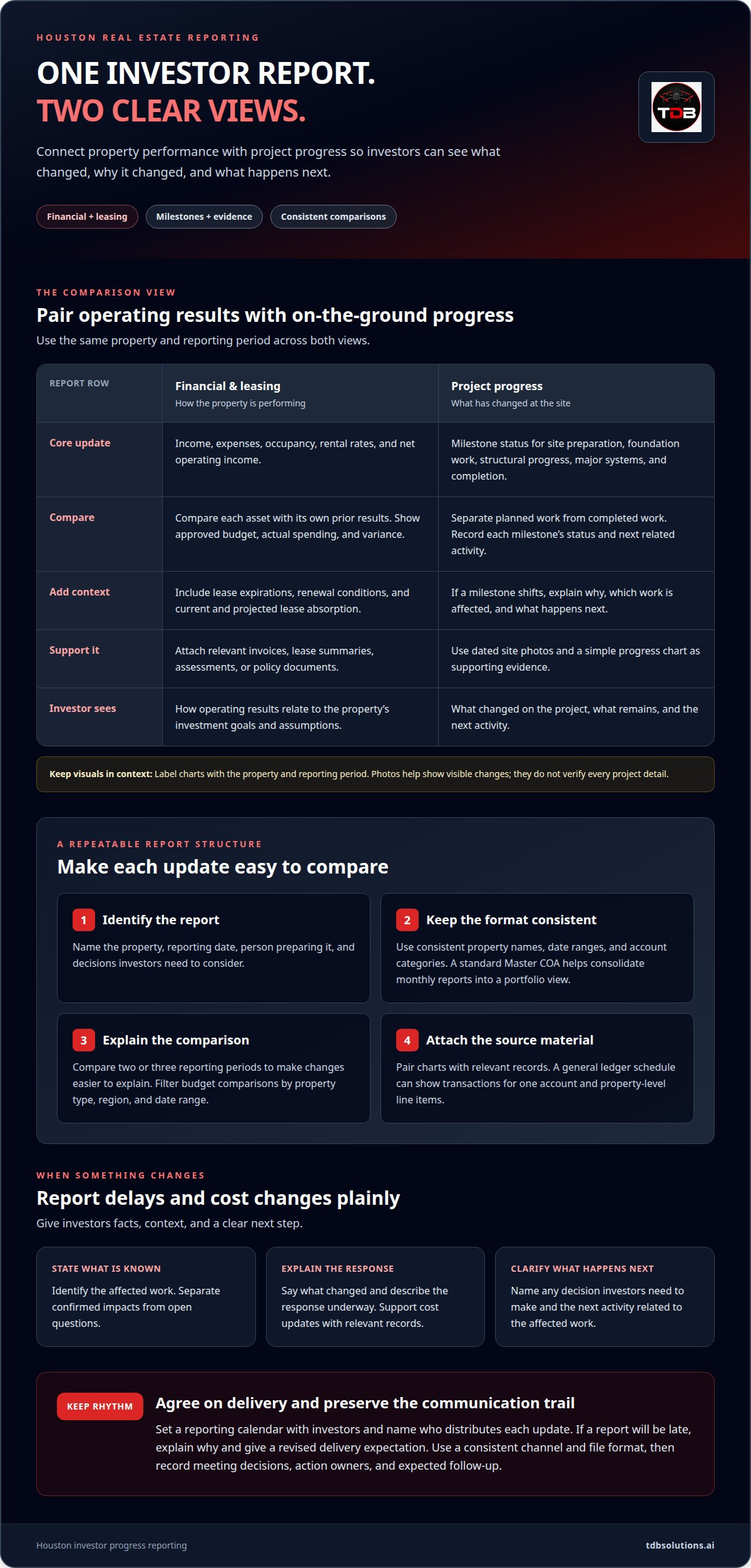
Centralize property and project updates so investors can compare performance without piecing together separate files. For Houston properties, tie financial results, leasing activity, and construction evidence to the relevant asset and reporting period.
Investor Report Contents
Build each update around property-level income, expenses, occupancy, rental rates, and net operating income. Add lease expirations, renewal conditions, and current and projected lease absorption so investors can assess leasing activity and upcoming decisions. For Houston market context, report rental rates, occupancy, and absorption by property, then compare each asset with its own prior results.
Use a repeatable template or shared dashboard with consistent property names, date ranges, and account categories. A standard Master COA, or chart of accounts, helps consolidate monthly reports into a portfolio view. Filter budget comparisons by property type, region, and date range to make relevant comparisons easier.
Budget, Spending, and Returns
Show the approved budget, actual spending, and variance for each reporting period. Summarize income, expenses, and net operating income across properties, and compare two or three reporting periods to make changes easier to explain. Relate net operating income and cash flow to the property’s investment goals and assumptions.
For Houston construction costs, property taxes, and insurance, use separate budget lines. Compare actual amounts with the project budget and prior periods, and explain changes with invoices, assessments, or policy documents. This shows local cost trends without presenting an unsupported market average or treating one property’s experience as universal.
Photos, Charts, and Supporting Documents
Use dated, consistent site photos to show visible changes between updates. Pair them with charts for budget variance, occupancy, rental rates, and absorption. Label each chart with the property and reporting period so investors do not compare unrelated figures.
Attach relevant invoices, lease summaries, and approved change records to support financial updates. A general ledger schedule can show transactions for one account and let asset managers review property-level line items. Source documents and clear visuals make the report easier to review and discuss.
Project Milestone Tracking
Track milestones that reflect the project scope, such as site preparation, foundation work, structural progress, major systems, and completion. For each, record its status, supporting evidence, and the next related activity. Separate planned from completed work so investors can see what has changed.
Pair milestone notes with dated photos and a simple progress chart. If a milestone shifts, state why, which work is affected, and what happens next. This gives partners a useful view of construction progress alongside financial and leasing updates, without suggesting that visual documentation alone verifies every project detail.
Investor relationships and partnerships
Investor communication works best as a two-way process. Set expectations early, make updates easy to discuss, and give partners a clear way to raise questions about a Houston project.
Investor Reporting Rules
Use the partnership’s written agreements and communication plan to shape investor updates. Specify who receives each report, the expected format, and how partners can submit questions. Choose an approach suited to the deal: a development partnership may need project-focused updates, while a property-holding group may prefer broader operating context. Keep the agreed process accessible to everyone preparing or reviewing communications.
Report Delivery Frequency
Make report delivery predictable by agreeing on a calendar with investors and naming the person responsible for distribution. If a report will be late, notify partners in advance with a brief explanation and revised delivery expectation. Use a consistent channel and file format so investors can find earlier messages and follow discussions. After each investor meeting, record decisions and assign owners.
Communicating Delays and Cost Overruns
Share bad news directly, starting with the known facts. Identify the affected work, explain what changed, and separate confirmed impacts from open questions. Then describe the response underway and any decision investors need to make. For example, if the work sequence changes, explain which activities are affected and how the project team is responding. Don’t bury the issue in optimistic language.
Common Reporting Mistakes
Trust can weaken when updates arrive through scattered channels, lack context, or leave investor questions unanswered. Avoid sending different versions to partners without explaining revisions. Don’t present estimates as completed results or describe a change without its project context. End each discussion by recording the agreed action, its owner, and the expected follow-up. This creates a clear communication trail without turning every update into a long memo.
For investor discussions that need stronger property context, use consistent visual records alongside written communication. TDB Solutions’ real estate media can help present a property’s setting and visible condition.
What information should a real estate investor progress report include?
Set a clear purpose before adding detail to each report. Identify the property, reporting date, person preparing it, and decisions investors need to consider. Open with a concise status note that separates completed actions from pending decisions. For example, state whether the team needs approval to revise a design, change a contractor, or proceed with a proposed next step.
Include a project risk register that names each active issue, its potential effect, the person responsible for addressing it, and the next action. Distinguish confirmed problems from risks that could develop. A Houston development report might flag a vendor dependency or unresolved design coordination item, then identify who will follow up and what decision could remove the obstacle.
- Decision log: Record the question, investor direction, responsible person, and follow-up status.
- Open items: List unresolved approvals, document requests, and coordination tasks with their owners.
- Assumptions: Identify planning assumptions that shape current recommendations, such as a proposed work sequence.
- Source notes: Name the project records or team updates used to prepare each key statement.
Show how each new report relates to the previous version. Mark revised sections, explain significant corrections, and keep a clear record of superseded files. This helps partners distinguish a new decision from a repeated discussion. Add a brief change note when a recommendation shifts, such as changing the work sequence after a design coordination review.
Close with a focused action list: what needs attention, who owns it, and what information will support the next decision. Keep recommendations separate from observed conditions so investors can distinguish documented facts from proposals. A Houston project report is easier to act on when every open item leads to a clear discussion or assigned follow-up.
Investors can use variance reports to compare performance with budgets and review differences across reporting periods. Pair the comparisons with concise explanations and follow-up actions so they can assess what changed and what needs attention.
How often should real estate investors receive progress reports?
Set update frequency according to the project’s pace, decision points, and investor communication needs. Active work may call for closer check-ins than a stable phase. To impress real estate investors with progress reports in Houston, establish a rhythm that keeps partners informed without sending updates that add no new information.
Separate scheduled reports from event-triggered messages. Scheduled updates give investors a regular view of the project; event-triggered notes address changes that need timely attention. This helps avoid waiting too long to share a meaningful development or sending frequent messages that repeat an unchanged status.
Use practical criteria to set the rhythm:
- Project activity: Increase communication during phases with active coordination or changing site conditions.
- Decision timing: Send relevant context before investors need to review or respond to a project decision.
- Change significance: Share an interim update when a development affects scope, sequencing, or a planned investor action.
- Information readiness: Send a report when its content is reviewed and coherent, rather than distributing incomplete fragments.
Review the cadence when the project enters a new phase. Coordination may call for a different flow of updates than execution or closeout. Ask whether each update helps investors understand a change, prepare for a decision, or stay oriented to current work. If not, combine that information with the next useful report. This is a practical way to impress real estate investors with progress reports in Houston without creating unnecessary communication.
Consistent visual documentation can also help explain changes between updates. Add visual project records when they give investors useful context about site conditions and completed work.
TDB Solutions: Construction Intelligence
TDB Solutions helps Houston property teams connect construction activity with clear visual updates through Construction Intelligence. Regular aerial documentation, site progress reports, volumetric measurements, and overhead oversight can add practical context to investor communications. Dated aerial views help partners follow visible site changes, while project measurements support informed discussions about work underway.
Turn to this service when scattered site photos make it difficult to compare progress or explain a project’s current condition. TDB Solutions also provides Aerial Inspections for remote visual examination of structures. Every flight is performed by FAA Part 107 certified pilots with full liability insurance.
If your investor updates need clearer construction documentation, contact TDB Solutions to discuss your Houston project.
Make Your Next Investor Update More Useful
Turn reporting into a repeatable operating habit. Assign an owner to each update, keep source records together, and connect project evidence to the decisions investors need to make. This gives partners a practical view of progress without adding noise.
If you’re learning how to impress real estate investors with progress reports in Houston, focus on making each update clear, timely, and easy to act on. Strong communication also depends on how you present the work. TDB Solutions offers Construction Intelligence, Custom Mobile-First Websites, and Marketing Media Production to support project documentation and investor-facing communication.
Bring your reporting goals and project needs into the next conversation. Contact TDB Solutions to discuss a practical next step for your Houston real estate project. Clear updates can help you build stronger working relationships, one decision at a time.
Frequently Asked Questions
What project metrics do real estate investors want to see in progress reports?
Investors need metrics tied to decisions, including phase completion, schedule status, and the effect of changes on the project plan. For each metric, identify its measurement basis, reporting date, and supporting evidence. A phase-completion percentage, for example, is clearer when paired with dated site documentation and a brief note on the work that remains. This helps Houston partners interpret progress consistently.
What are Houston construction costs, property taxes, and insurance trends to report?
Track construction costs, property taxes, and insurance as separate budget lines. Compare actual amounts with the project budget and prior periods, and explain changes with invoices, assessments, or policy documents.


