
The clearest view of a hazard may come from above, rather than from a worker standing beside it. To reduce jobsite safety risks with technology in Friendswood, construction teams can use drones to document hard-to-reach areas, safety apps to record hazards and follow-up, and AI video surveillance to flag visible risks such as missing PPE. These tools can help crews spot concerns and plan safer site operations.
Technology works best when it supports clear safety procedures, not when it replaces them. Drones can document site conditions, safety apps can organize hazard reports, and AI video surveillance can surface risks for follow-up. Understanding what each tool can and cannot do helps you choose practical ways to improve awareness across a jobsite.
Key Takeaways
- Use drone views to assess hard-to-reach or hazardous areas and plan inspections without sending workers into those locations first.
- Compare aerial records over time to track site conditions and spot changes that may need attention.
- Use safety apps to document hazards and guide follow-up, so workers and supervisors can act on clear, shared information.
- AI video tools can flag visible risks, such as missing PPE; treat alerts as prompts for crew review, not a replacement for safety procedures.
1. How do drones improve safety on construction sites?
Drones give supervisors a way to collect visual information before workers approach a hard-to-reach area. Aerial images of a damaged roof, unstable structure, or blocked access route can help the team decide what needs closer inspection. The footage also gives supervisors a shared reference for planning work zones and discussing hazards with crews. It supports assessment, but does not replace an on-site inspection or emergency procedures.
For high-hazard areas, remote images can inform damage assessment and emergency response planning. Robots can inspect places such as tunnels and storage tanks, where direct access may expose workers to danger. Choose a tool suited to the location and task: drones provide an aerial view, while robots can enter enclosed or difficult spaces. Review the collected information before assigning workers to inspect or address the area.
Technology serves different purposes. A drone documents visible site conditions, an app records reports, and a sensor monitors environmental exposure. To judge whether a tool helps, identify the hazard first, then consider whether the information supports a safer response. For small contractors, a practical first step is to test one tool against a recurring hazard and assess how well it fits the existing safety process.
OSHA’s federal construction industry standard, 29 CFR 1926, addresses personal protective equipment, safety training, and hazardous-material handling. Technology should support those established safety practices. To implement a tool, define the hazard, select a tool suited to the task, train the people who will use it, and decide who reviews its findings. Limit collected employee information to a clear safety purpose and set rules for access and retention.
On jobsites in Friendswood, Houston, Pearland, Galveston, and League City, assess site-specific conditions rather than assuming every project has the same hazards. Review access routes, work at height, moving equipment, and environmental conditions during planning. Use the findings to set inspection priorities and communicate controls before crews begin the affected task.
2. Drones for site inspection and operations monitoring
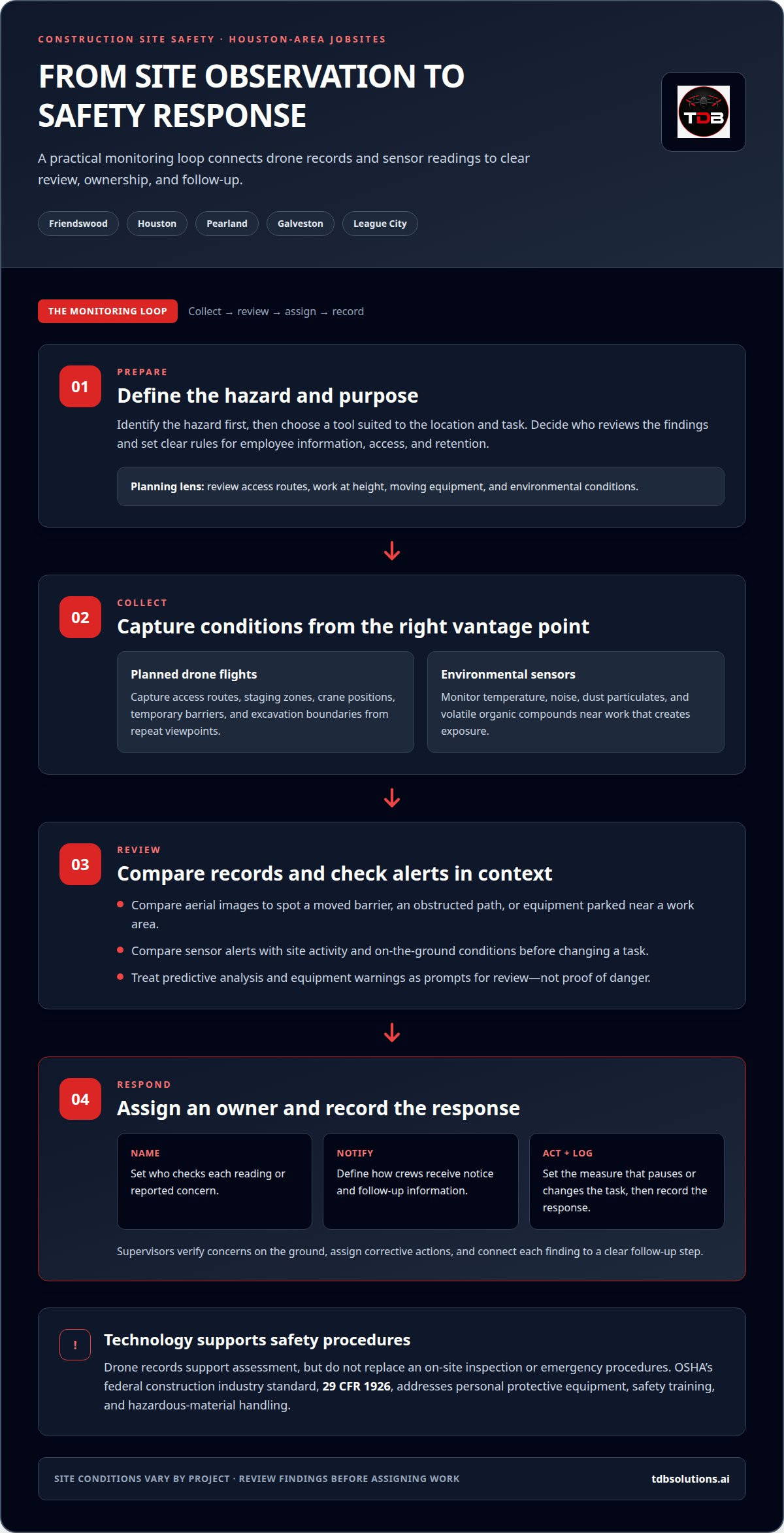
During active construction, planned drone flights give supervisors a consistent overhead record of changing site conditions. Capture access routes, staging zones, crane positions, temporary barriers, and excavation boundaries from repeat viewpoints. Comparing images can help teams spot a moved barrier, an obstructed path, or equipment parked near a work area. Aerial records support operations reviews, while supervisors verify concerns on the ground and assign corrective actions. To reduce jobsite safety risks with technology in Friendswood, connect each finding to a clear follow-up step.
Pair visual records with environmental sensors to monitor conditions workers can’t reliably judge by sight. Sensors can track temperature, noise, dust particulates, and volatile organic compounds. Place monitors near work that creates exposure, such as cutting materials or operating noisy equipment. Set response steps for alerts: name who checks the reading, how crews receive notice, and which measure pauses or changes the task. Technology can help employees respond earlier when readings connect to a defined site procedure.
Other sensors monitor equipment status and alert teams to developing hazards. An equipment warning, for example, can prompt a supervisor to inspect a machine before a fault disrupts work. AI systems can analyze safety records, incident reports, and environmental factors to identify patterns across tasks or locations. Predictive analysis can help teams schedule an inspection when equipment data signals a possible failure. Treat predictions as prompts for review, not proof of danger.
Build a practical monitoring loop: collect drone images and sensor readings, review changes, assign an owner, then record the response. A wearable device may add worker-specific information, while fixed sensors describe conditions across the work area. Compare alerts with site activity and on-the-ground reality before changing a task. For construction teams looking to reduce jobsite safety risks with technology in Friendswood, keep monitoring focused on useful measures and a defined purpose. If aerial records support your inspection workflow, aerial inspection services can help document site conditions for review.
3. Safety apps for assessing workplace hazards
Start with a repeatable task: recording hazards during a workplace walk-through. A safety app can help workers and supervisors document concerns involving noise, ladder use, and lifting practices. For example, a crew member can note a noisy work zone, describe the exposure, and share the concern with a supervisor. Consistent records help teams review recurring issues rather than rely on memory. Set a clear process for who reviews reports and how crews communicate corrective actions.
Wearable devices add information about individual conditions and nearby hazards. Depending on the device, they can monitor posture, exposure, or vital signs and provide feedback. A wearable that tracks body temperature, heart rate, and respiration may help identify fatigue or stress. Environmental-monitoring wearables can also alert employees to unsafe air quality or temperature. Use these signals to prompt a supervisor’s assessment, then connect the response to the task and site conditions.
Data science and AI can help teams find patterns across safety records, incident reports, and environmental factors. If reports repeatedly identify dust exposure around a particular task, managers can prioritize that work area for review. Predictive analytics can also help construction teams rank higher-risk locations and direct safety resources where they may be most useful. The value comes from acting on a pattern: review the reports, assess the hazard, and plan a suitable control.
For hazards that are difficult to reach, robots can inspect locations such as tunnels and storage tanks and collect samples. This gives teams information to assess before sending workers into those environments. Virtual reality and augmented reality offer another practical option: crews can rehearse a task or hazardous scenario before performing the work. Use an app to capture the assessment, record follow-up, and share relevant steps with workers. Together, these tools support a clear cycle of reporting, review, and prevention.
4. AI video surveillance and safety insights
AI video surveillance can turn camera footage into prompts for safety review. Video analytics can monitor facilities and driving behavior, then alert managers to potential risks in real time. On a construction site, a system may flag a worker who appears to lack required PPE. A supervisor can review the footage, confirm what happened, and address the issue with the crew.
Use alerts to direct attention, not to make the final safety decision. A camera may miss context, such as a worker removing a hardhat in a designated safe area. Set a clear review process: identify the camera location, check the clip, assess the surrounding task, and record any follow-up. This keeps safety technology tied to real work conditions instead of treating every alert as proof of a violation.
AI insights can also help managers compare recurring patterns across locations or tasks. For example, repeated alerts around vehicle movement could prompt a review of traffic flow, visibility, or pedestrian access. Pair video findings with incident reports and site observations to decide whether a process needs attention. Wearable technology and other devices may add different signals, such as fatigue indicators, but each data source needs a clear safety purpose.
Plan privacy and employee training as part of implementation. Explain what cameras monitor, who reviews footage, and how teams use the information. Limit access to people responsible for safety review, and set practical rules for storing and removing recordings. Train supervisors to interpret alerts consistently, discuss concerns with workers, and keep video use within its stated safety purpose. These steps help employees understand how monitoring supports hazard prevention.
Before activating AI monitoring, map camera coverage to specific hazards and define who responds to each alert. Review whether the system detects risks that matter on your site, including PPE gaps or unsafe vehicle behavior. Then evaluate alert accuracy with supervisors and workers. Where useful, pair that feedback with virtual reality safety practice, so crews can rehearse responses instead of relying on camera alerts alone.
TDB Solutions: Construction Intelligence
TDB Solutions helps construction teams improve project visibility through Construction Intelligence and Site Progress & Documentation. When you need to document changing site conditions, review progress, or support operational planning, aerial imagery provides a useful visual record. TDB Solutions also provides Critical Asset Inspection to assess structures and hard-to-reach areas remotely, adding visual context to a site review.
Use aerial information alongside established safety procedures and on-site assessments. Drone imagery can inform decisions, but it does not replace safety training, hazard controls, or qualified inspection work. For construction teams in Friendswood, Houston, Pearland, Galveston, and League City, aerial documentation can make site conditions easier to review and share.
Contact TDB Solutions to discuss Construction Intelligence for your project.
Make your next safety improvement measurable
Make safety improvement an ongoing operating practice, not a one-time technology purchase. Choose a process owner, agree on what information crews need before work starts, and schedule regular reviews as site conditions change. Invite foremen and workers to identify friction points, such as duplicate reporting or unclear handoffs. Record what the team changes and whether the revised process helps people act with greater clarity. This gives you a useful basis for deciding what to adjust next.
For teams in Friendswood, Houston, Pearland, Galveston, and League City, reducing jobsite safety risks with technology works best when crews understand the process and supervisors can maintain it. TDB Solutions’ Construction Intelligence can support project visibility, while Custom Mobile-First Websites and Marketing Media Production support business communication needs. Choose support that fits your next priority, then assign clear ownership for follow-up. Keep the plan practical so safety improvements move with the project rather than becoming another unused procedure.
Contact TDB Solutions to discuss safety and identify a useful next step for your project.
Frequently Asked Questions
How do drones improve safety on construction sites?
Drones can help teams document site conditions around a specific operation, such as a delivery or equipment move. Before work begins, capture the route and nearby obstacles, then use the imagery to support the crew’s pre-task discussion. After the operation, compare the site view with the planned setup. This gives supervisors a practical record to inform future work planning.
How does wearable technology enhance safety in construction?
Some wearables add proximity detection or fall alerts to a worker’s protective equipment. For example, a proximity device can warn when a worker approaches moving equipment or a restricted zone. A push-button alert can also give workers a direct way to report an injury or urgent concern. Set expectations before use so employees know what each alert means and who responds.
What Technology is Being Used to Make Construction Sites Safer?
Construction safety tools also include vehicle telematics, task-support robots, and exoskeletons. Telematics combines GPS with onboard diagnostics to track vehicle location, status, and behavior. Robots can take on repetitive or lifting tasks, while exoskeletons support workers during physically demanding work. Choose technology by matching its role to a specific task, such as monitoring vehicle movement or reducing physical strain.
What are the benefits of AI-powered systems in construction safety?
AI-powered tools can help supervisors organize safety information and direct attention to items that need human review. For example, a flagged event can prompt a discussion during a crew briefing, while the supervisor records the decision and any follow-up. This creates a more consistent review process than relying on memory alone. Keep a person responsible for interpreting the result and deciding what action fits.
What are the main challenges facing construction safety today?
Coordinating safety across multiple trades can be difficult because crews, equipment, and work areas change throughout a project. A control that works for one task may not suit the next crew’s work zone. Before each phase, clarify who owns shared areas, how changes reach affected teams, and how supervisors resolve conflicting work plans. That coordination helps prevent gaps between separate crews’ safety procedures.
What is predictive analytics, and how does it apply to construction safety?
Predictive analytics uses past data to estimate where attention may be needed next. A construction team can define a question, such as which work phases produce repeated safety concerns, then review records for relevant patterns. Managers can use the resulting forecast to shape upcoming briefings or inspection priorities. Afterward, compare the forecast with actual site events and refine the approach as conditions change.


