
Could your logo look polished on a business card but feel like a different company on your website or social pages? That disconnect can make it harder for customers to recognize your business. Logo and branding Houston small business owners can use consistently starts with more than a mark. It needs a clear visual identity that works wherever customers encounter you.
You may be deciding whether to invest in a logo alone or build a broader identity. The logo is one piece. Colors, typography, image style, and supporting graphics help create a consistent look across your website, social media, printed materials, and other customer touchpoints.
This article explains how those elements work together and what to keep consistent as your business grows. You’ll also learn how in-house graphic design can turn your branding into practical marketing assets, including visuals for your website. Whether you serve customers in Houston, Friendswood, Pearland, Galveston, or League City, a coherent identity helps your business look connected wherever people find you.
Key Takeaways
- Use your business goals and audience to guide branding decisions before design begins.
- List where customers encounter your business, from your website to printed materials, so your visual identity works across each touchpoint.
- A focused logo refresh may be enough when the main issue is legibility or inconsistent logo use; broader branding can address wider visual needs.
- A practical logo and branding Houston small business plan connects design choices to the materials you need to represent your company consistently.
- TDB Solutions brings branding, in-house graphic design, and custom mobile-first web design together to support a coherent business identity.
Why Houston Small Businesses Need More Than a Memorable Logo
Your logo looks one way on your website, another on social media, and different again on a flyer. Customers may recognize your name, but inconsistent colors, type styles, and images can make the business feel disconnected across those encounters. In Houston and nearby communities, familiar visual cues help customers identify your business when they see it again.
Brand identity is the set of visual choices that gives your business a recognizable, consistent look wherever customers encounter it. A logo is part of that identity, not the whole system. For a wider overview of the meaning and history of a brand, see What is a Brand?
What customers notice before they know your business
Before a customer knows your work, they see how you present it. Your logo, color palette, typography, and images create an initial impression. Imagine a Friendswood bakery using warm, handmade-style photos on its website, stark corporate graphics on social media, and a stretched logo on printed menus. Each piece may look fine alone, yet together they don’t feel like one business.
Consistency doesn’t mean every Houston-area business should look alike. A Galveston property service may choose visuals suited to coastal homes, while a Pearland accounting firm may favor a more restrained style. The goal is not to copy a local trend. Choose visual cues that fit your business and repeat them reliably.
When a small-business logo is no longer doing its job
A logo may need attention if the name is hard to read at small sizes, different versions appear across materials, or the design no longer reflects the business you run. Check how the mark works in real settings, from a phone screen to a printed handout.
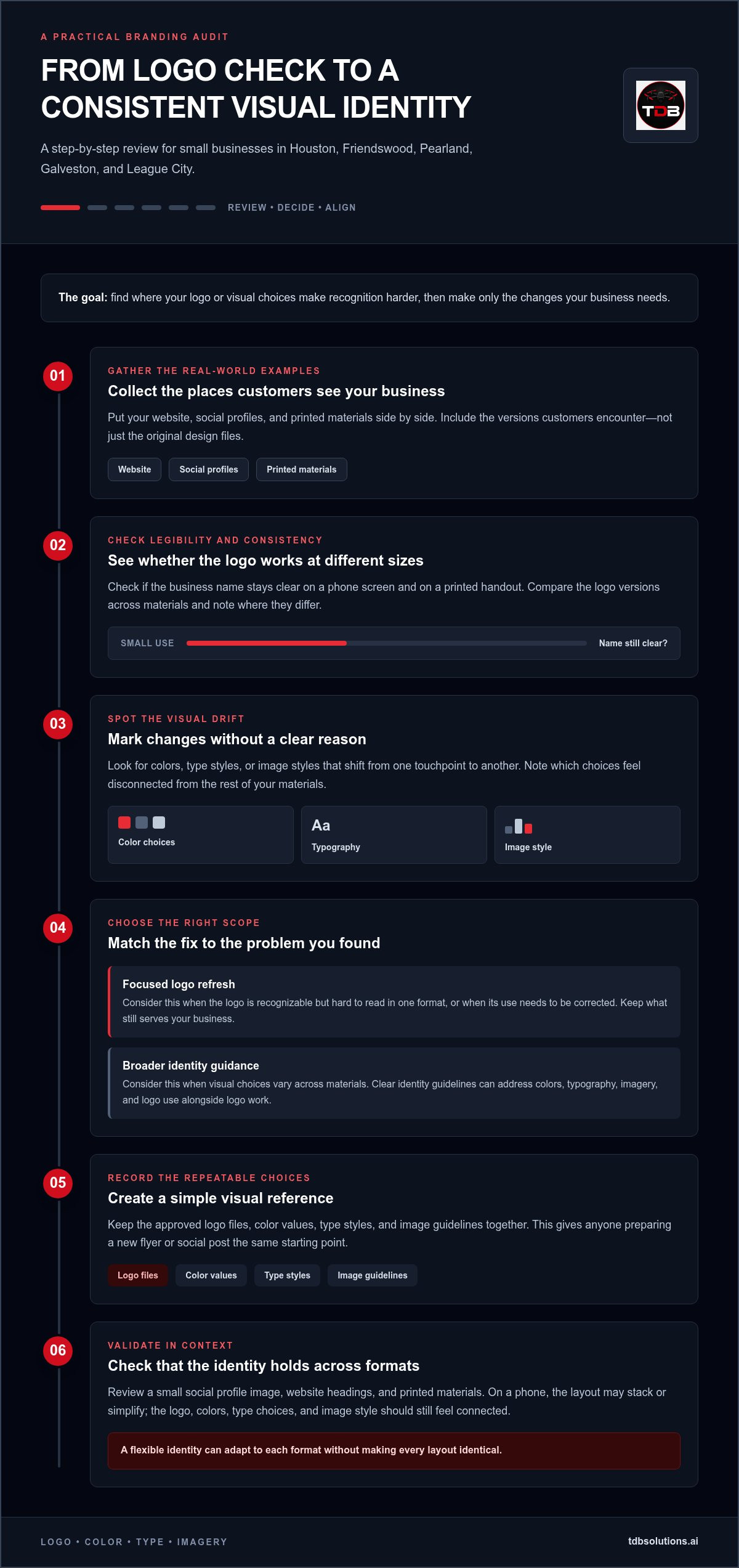
A useful review starts with a quick touchpoint check:
- Compare the logo on your website, social profiles, and printed materials.
- Check whether the business name stays clear at different sizes.
- Note where colors, type, or image styles change without a clear reason.
Then decide whether you need a focused refresh or a broader change. If the logo is recognizable but difficult to read in one format, improve its legibility or correct inconsistent use without discarding what customers already know. If visual choices vary across materials, the issue may call for clearer identity guidelines as well as logo work. The logo and branding Houston small business owners choose should solve a real communication problem, not change simply to look new.
Keep what still serves your business and update what makes recognition harder. A consistent identity gives customers a clearer visual thread as they move between your website, social pages, and printed materials.
Logo vs. Brand Identity: What Houston Small Businesses Should Build
A logo gives customers one visual mark to recognize. A brand identity gives that mark a consistent setting: colors, typography, imagery, and graphic design that work together across your business materials. A logo is the signature; a visual identity is the full visual system that makes your business recognizable.
That distinction helps you decide what to create. If you need a clear mark for one immediate use, a logo may meet the need. If customers see your business on a website, social media, proposals, and printed pieces, the surrounding visual choices matter too. They help different materials feel connected without making every layout identical.
The visual elements that make a brand feel consistent
Color and typography create a repeatable visual pattern. A chosen color palette can guide backgrounds, headings, and accents, while type choices establish how your business presents its name and information. Neither needs to follow a universal formula. A contractor serving League City and a Friendswood wellness studio may need very different visual directions to reflect their work and audience.
Photography and graphic design carry that direction further. Choose imagery and supporting graphics that fit your logo and the way your business communicates. For practical consistency, record approved logo files, color values, type styles, and image guidelines in a simple reference document. Anyone preparing a new flyer or social post can then use the same starting point.
How branding carries from a logo to a business website
Your website should feel like part of the same business customers meet in your other materials. Carry over the same logo, colors, type choices, and image style, while adapting their placement to the page. A mobile-first website also needs those elements to stay clear on smaller screens, where a busy logo or cramped text can be harder to read.
Consider a Pearland home-services company. Its logo may appear at the top of its website, on a service flyer, and on social profiles. The layouts can change, but consistent colors, typography, and photography help customers connect each item to the same company. On a phone, the website may simplify the layout and stack content vertically; the arrangement changes, not the identity.
Before approving design work, check how the identity performs in actual contexts. Can customers read the business name in a small profile image? Do the website headings and printed materials feel like they belong to the same company? Does the photography support the impression you want to make? These checks help you build a flexible system instead of forcing one design into every format.
For a connected approach, explore TDB Solutions’ branding and graphic design, paired with custom mobile-first web design for businesses in Houston and nearby communities.
Logo-Only Design vs. Consistent Branding: What Fits Your Business?
You don’t have to choose between fixing a logo today and planning every future marketing asset. Start with the problem you need to solve. A focused logo update can address a specific issue with readability or use. A broader visual identity can set direction across several materials when those pieces feel unrelated.
For a logo and branding Houston small business decision, consider what customers need to recognize and where they encounter your business. The right scope depends on your goals, audience, and current materials, not on a rule that every small business needs a full rebrand.
When a focused logo refresh may be enough
Keep the scope narrow if your existing look still fits the business but the mark causes a specific problem. The business name may blur at small sizes, for example, or staff may use different logo files and placements. A refresh can clarify the artwork and its approved uses while keeping recognizable elements intact.
This approach can work when you need the logo to read clearly on a website header, social profile, or printed handout. It avoids changing familiar design choices without a business reason.
When a wider identity system makes more sense
Look beyond the logo if mismatches keep appearing across your website, social graphics, and business materials. Each item may use different colors, type styles, or image treatments. Coordinated graphic design can give those pieces a shared direction while allowing each layout to fit its purpose.
Build that direction around what you want customers to understand about your business. A professional firm and a neighborhood food business may need different visual cues. The goal is fit and consistency, not a template shared by every Houston company.
Use this quick decision guide before briefing a designer:
- Choose a logo refresh if one specific issue, such as legibility or inconsistent placement, is the main concern.
- Consider a wider identity if several materials look disconnected or you’re creating marketing pieces without a shared design direction.
- Set priorities by listing the materials you need now, such as a logo file, social graphics, or business stationery.
- Plan in stages if you can’t address every touchpoint at once. Establish a usable direction first, then apply it as you create new materials.
Branding can grow with your business. You can begin with a clear logo and add coordinated assets as your needs develop. Make each design decision serve a real purpose for your audience and daily operations. If you’re ready to shape that direction, explore TDB Solutions’ branding and graphic design for your business.
A Practical Houston Small-Business Branding Brief Before Design Begins
A clear brief gives design work a job to do. Before requesting a logo or new marketing graphics, write down what customers should understand about your business and where they’ll see your identity. A useful brand brief helps a designer choose visual elements that fit your goals, audience, and real-world materials.
Use this preparation sequence to turn broad ideas into practical direction:
- Set a business goal. State what you want the design to support, such as introducing a new service, clarifying what your company does, or making your materials feel more connected.
- Describe your audience. Identify who you serve, where they’re located, and what they need to understand first. A Pearland home-service business might want homeowners to recognize the service quickly and feel confident contacting the company.
- Define the impression. Pick a few specific words tied to your work. “Precise, approachable, and dependable” gives clearer direction than “modern” or “professional” alone. Explain what each word means for your business.
- Map the touchpoints. List every place the identity needs to work, including your mobile website, social graphics, printed materials, proposals, and signage if relevant. Note which items you need first.
- Review what you have. Gather current logos, photos, colors, and marketing pieces. Mark what still fits, what creates confusion, and what you want to replace.
Clarify your audience, services, and desired impression
Be specific about the work you do and the people you serve. A League City landscaping company may want customers to understand its services and local focus, while a Houston consultant may need to communicate expertise clearly. Neither needs generic skyline art or familiar Texas symbols by default. Use local context to clarify your audience and service area, not as a substitute for a design direction.
Map the places your branding needs to work
Think about format as well as appearance. A logo may need to read clearly in a compact mobile header and on a printed flyer. Social graphics may need a repeatable layout, while a proposal may call for a more restrained treatment. List the materials you use now and expect to create next, then flag any existing visuals worth keeping.
For a broader look at how local context can shape an identity, explore Business Branding in Houston, Texas: Build a Distinct Local Identity. Use the same practical lens in your brief: what should customers recognize, and where must they recognize it?
Bring your goals, audience notes, touchpoint list, and existing materials into the design conversation. This gives the work a clear starting point and keeps decisions tied to your business rather than passing trends. Start your branding and graphic design project with TDB Solutions.
How TDB Solutions Brings Houston Small-Business Branding Together
You’ve identified the visual problems to solve and the places your identity needs to work. TDB Solutions connects that planning to practical design services: branding, in-house graphic design, and custom mobile-first web design. Each supports a different way customers encounter your business, from a printed flyer to your website on a phone.
For a logo and branding Houston small business project, match the design scope to your needs. You might need a clear logo and coordinated marketing graphics, or a wider visual direction that carries into a new website. Either way, start with your business goals, audience, and actual touchpoints.
In-house graphic design for a clearer visual identity
Graphic design creates visual assets such as logos, flyers, and social media graphics. TDB Solutions provides in-house graphic design for logos and marketing assets, helping bring key visual materials under a shared direction.
For example, if you use a logo on a flyer and social graphics, coordinated design can help those pieces feel like they belong to the same business. The layouts may differ to suit each format while the visual direction stays connected. That gives you practical marketing materials without treating each new item as a separate design problem.
Branding that connects with a mobile-first business website
Your website is another key touchpoint. TDB Solutions creates custom mobile-first websites, carrying your visual direction into a site designed for clear use on smaller screens. The logo, colors, typography, and imagery can support a consistent presentation while the page layout adapts to the device.
That connection matters when customers move from a social post or printed material to your website. They should recognize the same business, even though the format changes. Planning visual assets and your website together can keep the site from feeling like an unrelated design task.
TDB Solutions is based in Friendswood and serves Houston, Pearland, Galveston, and League City. If you’re ready to discuss branding, graphic design, or a mobile-first website for your business, talk with TDB Solutions about your branding. Bring the materials you use now and the touchpoints you want to address. That’s a practical starting point for shaping design work around your business.
Put Your Brand Identity to Work
Make your next branding decision with a real customer task in mind. Ask what someone should understand or do after seeing your materials, then use the answer to judge whether a design choice belongs. This keeps logo and branding Houston small business decisions grounded in how people interact with your company, not in design trends alone.
Choose one practical measure of clarity, such as whether a new customer can quickly identify your business or find the right contact information. Use it to guide reviews as your materials evolve. Small, deliberate decisions can help your identity stay useful as your business grows.
Bring your priorities and questions to the conversation. Talk with TDB Solutions about branding for your small business and identify a practical starting point. You can move forward with purpose, one clear decision at a time.
Frequently Asked Questions
Can a logo be redesigned without losing the recognition customers already have?
Yes. Keep familiar features that still work, such as the business name, a recognizable symbol, or a distinctive shape, while correcting specific design issues. For a logo and branding Houston small business refresh, compare the current and proposed marks at the sizes customers actually see, including a social profile icon and a website header. Updating supporting materials in stages can also help customers connect the revised logo with the business they know.
How often should a small business review its branding?
Review it when something meaningful changes, not just because a certain amount of time has passed. A new service, a shift in audience, or a change in how customers find you can signal that your visuals need another look. You can also include a brief check during routine marketing planning. Ask whether your materials still represent the business accurately and whether staff can identify the current approved logo files.
What file formats should a small-business logo be prepared for?
Ask for a vector format, such as SVG or PDF, for resizing without losing sharpness, plus raster files such as PNG and JPG for everyday digital use. A transparent PNG helps when the logo sits over a colored background; JPG works for simple images on a solid background. Keep an original editable file if provided, and label versions clearly so you can find the correct file for each task.
Is a tagline necessary for a small-business logo?
No. A tagline is optional, and the logo should still work without one. Add a tagline only if it clarifies what you do or communicates something the business name alone doesn’t. Test it at small sizes: if the words become difficult to read on a phone or a compact print piece, use a logo version without the tagline for those applications. Keep the wording short enough to read at a glance.
Can a small business use different logo versions for different materials?
Yes. A business can use a full logo, a compact arrangement, or a symbol-only version for different layouts, provided each version follows the same design rules. For example, a wide logo may fit a website banner, while a simplified mark may suit a square social avatar. Decide which version belongs in each setting, and avoid stretching, recoloring, or rearranging elements on the fly.
What should I prepare before starting a branding project?
Gather your current logo files, recent marketing pieces, and examples of customer questions or feedback about how people understand your business. Note any names, service descriptions, or contact details that must stay accurate across materials. If several people approve design decisions, identify who gives final sign-off. This groundwork helps keep revisions focused on the business message and practical use, rather than conflicting opinions about personal style.


