
The self-managed video production vs. professional business interview agency decision comes down to your team’s time, production skills, and need for a dependable shoot. Self-managed production gives you direct control and can suit simple, frequent videos. An agency is often the stronger fit for an important interview that needs coordinated planning, experienced filming, editing, and backup equipment.
Keeping production in-house can seem like a straightforward way to control the process. But the work goes well beyond pressing record: scheduling, sound, lighting, editing, and reshoots all require time and attention.
This guide compares how each option affects scheduling, creative control, and contingency planning, and explains how a hybrid approach can work for regular content and higher-stakes projects. Use the comparison to decide what your team can handle and when professional production support makes sense.
Key Takeaways
- Plan backup audio, camera, lighting, and cable options before filming so one equipment problem doesn’t derail an interview.
- Compare self-managed production with freelancers and agencies by counting staff time, equipment needs, and post-production work, not just the shoot itself.
- Choose the production setup that fits your schedule and desired creative control; a hybrid model can balance routine content with major projects.
- For construction-focused visuals, connect the production decision to how you’ll document site progress and communicate project information.
Backup equipment and contingency planning
A professional business interview agency can manage planning, filming, editing, and delivery. Its crew may also bring backup cameras, cables, lights, and microphones, reducing the chance that one equipment failure stops production.
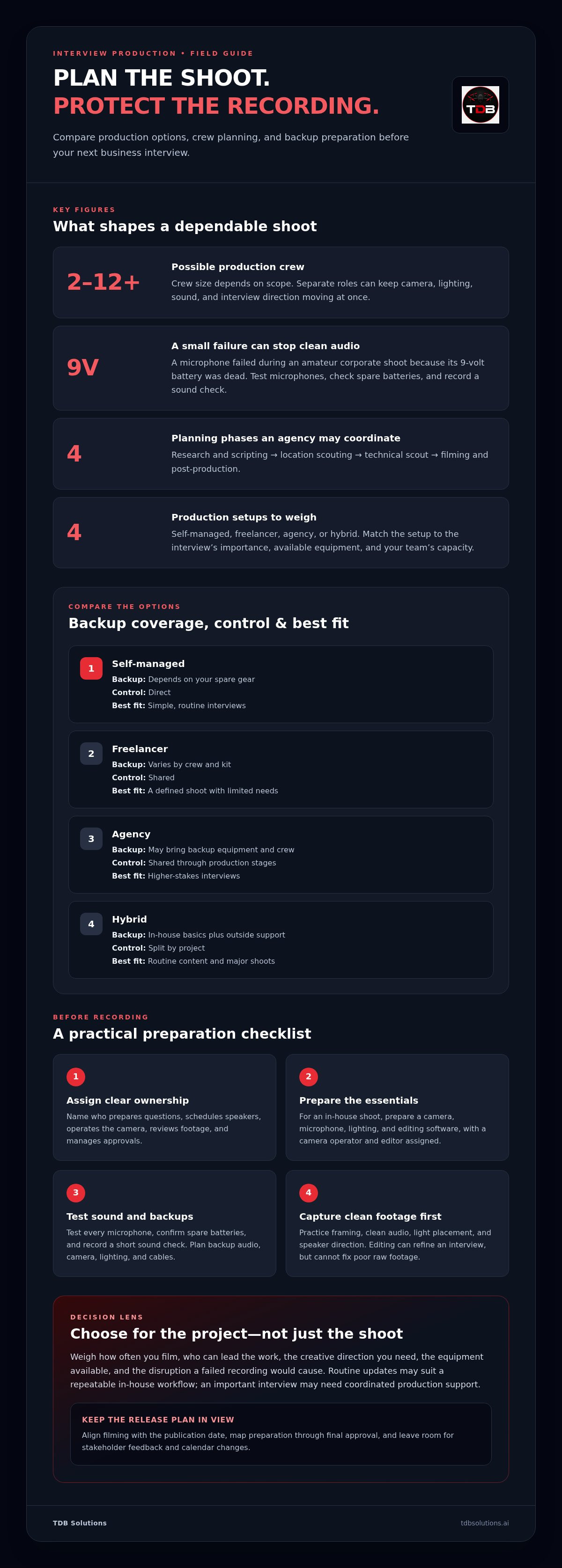
That preparation matters even with simple gear. In one amateur corporate shoot, a prosumer microphone stopped working because its 9-volt battery was dead. Before filming, test every microphone, confirm spare batteries, and record a short sound check. Clear dialogue gives editing more usable material.
Agencies can plan the shoot in stages: research and scripting, location scouting, a technical scout for power and equipment needs, then filming and post-production. Depending on scope, a production crew may include 2 to 12 or more people. Separate crew roles can keep camera operation, lighting, sound, and interview direction moving at once.
| Option | Backup coverage | Control | Best fit |
|---|---|---|---|
| Self-managed | Depends on your spare gear | Direct | Simple, routine interviews |
| Freelancer | Varies by crew and kit | Shared | A defined shoot with limited needs |
| Agency | May bring backup equipment and crew | Shared through production stages | Higher-stakes interviews |
| Hybrid | In-house basics plus outside support | Split by project | Routine content and major shoots |
Choose based on the interview’s importance, the equipment available, and the disruption a failed recording would cause.
To produce interviews in-house, assign a camera operator and editor, and prepare a camera, microphone, lighting, and editing software. You’ll also need skills in framing, capturing clean audio, positioning lights, and directing the speaker. A quiet room and a tested backup microphone can help avoid unnecessary retakes.
Good editing can improve pacing, motion graphics, and audience focus, but it can’t fix poor-quality raw footage. Harsh shadows or background noise, for example, may require extra takes or a reshoot. Capture clean footage and sound first; use post-production to refine the interview, not rescue it.
In-House Video Production vs Hiring a Video Production Company: What’s Right for You?
The right setup depends on how often you film, who can lead the work, and how much creative direction you need. Compare the responsibilities and workflow before assigning your next interview.
Freelancer and Production Company Roles
A freelancer can handle a defined task, such as filming an interview or editing footage your team captured. A production company can coordinate several stages and specialists on a larger project. For example, a company preparing a conference interview series may need one partner to align speakers, filming, graphics, and final versions. Choose an arrangement that matches your project’s scope and your team’s capacity.
Ongoing and Project-Based Workflows
An in-house team can build a repeatable process for routine updates, product demonstrations, or staff training. External crews can suit projects with specific creative or technical needs. Decide whether you need a dependable internal workflow or a dedicated production team for a particular release. A consistent interview format helps employees contribute regularly without rebuilding the process each time.
In-House Team and Production Responsibilities
Self-managed production puts planning and execution in your employees’ hands. Assign responsibility for preparing questions, scheduling speakers, operating the camera, reviewing footage, and managing approvals. For a customer interview, one employee might coordinate the guest while another checks the recording setup. This keeps decisions close to your organization, but employees need enough time and clear ownership for each task.
Planning and Production Decisions
Set the audience, message, format, and intended channels before choosing a production model. For U.S. business interviews, plan written appearance permissions, use music cleared for the intended video, and keep private documents or personal information out of frame. These are practical safeguards, not a summary of legal requirements. An agency can guide production, while an internal team offers direct involvement. Choose the model that supports your goals and review process.
Agency scheduling, cost, and control trade-offs
Agency involvement changes how you coordinate interviewees, production dates, and creative approvals. Set expectations early so the filming plan fits your team’s calendar and the video’s purpose.
Interviewee Scheduling and On-Camera Comfort
Schedule around the speaker’s availability, location access, and the crew’s production plan. Share interview topics in advance so speakers can prepare clear examples without memorizing a script. If an executive seems stiff on camera, start with a short conversation before recording and let them answer in their own words. This helps the interviewer find a natural pace and identify useful follow-up questions.
Your team can simplify scheduling by naming one contact to coordinate speakers. That person can share arrival details, confirm the interview location, and collect changes in advance. Fewer last-minute messages help the interviewee arrive prepared and keep the shoot focused.
Scheduling and Deadlines
An agency plans around agreed production stages, so align filming with your launch or publication date. Map the steps from interview preparation through the shoot, review, and final approval. Leave room for stakeholder feedback and calendar changes. A video production company may allow schedule buffer for unexpected events, but the release date still depends on timely decisions from your organization.
For a social media series tied to a conference, identify interview windows before the event begins. A clear run sheet helps speakers, crew, and internal staff know where to be and when.
Agency Scheduling and Control Trade-Offs
Agency direction can simplify technical decisions while your team retains control of the message and approvals. Agree on who selects interview questions, approves the edit, and requests changes. A single decision-maker can keep feedback consistent and prevent conflicting revisions from different departments.
Self-managed production gives employees more direct control over filming choices, but they also handle coordination and follow-through. Agency support shifts some production work to specialists. Choose the workflow that fits your team’s availability, desired involvement, and need for a coordinated shoot.
Benefits of hiring a professional video production company
A production company can take a corporate video from concept through delivery. This can help when your organization needs a clear message and consistent execution without adding production tasks to internal staff.
Start with the story. A production team can shape the interview goal, research the subject, write questions, and plan the location. During filming, a director guides the speaker while camera and sound professionals capture usable takes. Editors can then refine pacing, sound design, color, and motion graphics. A coordinated workflow connects the original vision to the final video.
Technical choices affect what viewers see and hear. For an executive interview in a busy office, a crew can assess the room, choose a boom or wireless lavalier microphone, and position lights to control shadows. A technical scout can identify power locations and equipment needs before shoot day. These steps help prevent avoidable noise, poor exposure, and repeated takes.
Outside support can be useful for a product launch, recruitment campaign, or high-impact brand film. Your employees can focus on their roles while the production team manages filming, direction, and timeline coordination. If decision-makers can’t attend in person, a crew may stream the interview shoot for review. Define the audience and primary viewing platform early, then match framing and delivery format to that use.
A professional team can also bring a fresh perspective to how you present your organization. It can turn a technical explanation into a concise interview or shape one conversation into versions for a website, social media, and internal training. This helps when the message needs different pacing or context across channels. Keep the core claims consistent and approve scripts before filming.
Choose professional support when the interview carries reputational weight, requires several production stages, or needs advanced creative and technical execution. For a quick internal update, your team may prefer direct control. For a campaign where message, sound, and visual polish all matter, plan your next marketing video project with production needs and audience in mind.
TDB Solutions: Construction Intelligence
TDB Solutions provides Construction Intelligence for teams that need clear, useful information about active jobsites. If your goal is tracking site progress rather than producing an executive interview, aerial documentation and site progress reports can help communicate project conditions over time.
Choose a format that fits the task. Marketing Media Production supports business content, while Aerial Inspections help assess structures and hard-to-reach areas. Custom Mobile-First Websites give clients and prospects a clear place to view your company’s work and project information.
For construction firms, connect visual documentation to the decisions your team needs to make. Define what you want to record, who needs the information, and how you plan to share it. Contact TDB Solutions to discuss Construction Intelligence for your project.
Choose the Next Step for Your Video Strategy
Base your production decision on what the finished content needs to achieve. If an interview will deliver a major announcement or introduce your organization to new customers, plan the creative direction, approvals, and production responsibilities before booking a shoot. For routine updates, an in-house process may keep your team closer to the message. The right balance can vary by project.
The choice between self-managed video production and a professional business interview agency also connects to your broader marketing plan. TDB Solutions offers Marketing Media Production for business content, Construction Intelligence for communicating project information, and Custom Mobile-First Websites to present your work online. These services support different goals, from sharing a company story to giving construction clients clearer project context.
Set your next objective, identify the audience, and decide what support would help your team move forward. Contact TDB Solutions to discuss your project and choose a practical next step. Your video plan can start with a clear goal and grow from there.
Frequently Asked Questions
From Concept to Post-Production: What’s Involved?
A business interview moves from a clear message to a finished asset through a series of connected decisions. Start by naming the audience and the single takeaway you want viewers to remember. Prepare interview prompts, confirm the speaker’s title, and choose a location that suits the subject. After filming, review the edit for factual accuracy, names, and context before approving captions and final versions.
When does hiring a professional video agency make more sense?
Hire an agency when a video has high visibility, involves several stakeholders, or calls for creative skills your staff can’t provide alongside regular duties. A product launch, recruitment campaign, or executive message may need coordinated direction and a consistent visual style. Agency support can also make sense when you need several finished versions from one interview, such as a full website video and shorter social media edits.
Which organizations benefit most from building an in-house team?
Organizations with frequent, repeatable video needs may benefit most from in-house production. A company creating many instructional videos, for example, can build a familiar workflow around subject experts, internal reviewers, and recurring formats. In-house staff also learn the organization’s terminology and culture. This approach works best when leaders can assign ongoing time for filming, editing, equipment upkeep, and publishing.
What does self-managed business interview video production involve?
Self-managed production means your employees own the work from preparation through delivery. Assign one person to coordinate the speaker, questions, location, recording, file backups, and edit approvals. For example, a communications manager might schedule an executive, record the interview, and work with an editor on revisions. Your team retains direct control, but must also track decisions and deadlines.
How much does DIY business interview video production cost in the US?
There’s no fixed total for a do-it-yourself interview. Build your estimate around staff time, equipment you already own, rentals, training, editing tools, and potential reshoots. A camera your organization already uses changes the equipment needs, while a new setup or outside editing adds separate expenses. Track both spending and employee hours to understand the project’s full resource impact.
How much do professional interview video production agencies charge?
Agency charges depend on project scope, crew, filming requirements, and post-production deliverables. A single interview with a straightforward edit differs from a campaign that needs scripting, graphics, multiple versions, or extensive review. Ask for the work to be defined by deliverables and production stages so you can compare the proposed scope with your audience, intended use, and internal approval process.


