

What if your theft-prevention plan depends on knowing where materials and equipment are as work zones shift? With drone asset tracking construction sites Houston teams can add overhead visibility, but aerial images aren’t a live inventory or a way to locate individual assets in real time. They provide a visual record of changing site conditions. Ground-level controls still secure equipment and establish responsibility.
You need a repeatable plan that follows the jobsite, not a one-time checklist that quickly falls out of date. This guide explains how to assign responsibility for tools, materials, and equipment; choose practical controls for your site layout and work phase; and build a routine for checking vulnerable areas. It also covers where recurring drone documentation fits into that routine, and where it doesn’t.
TDB Solutions provides construction intelligence and regular aerial documentation across Houston, Friendswood, Pearland, Galveston, and League City. FAA Part 107 certified pilots capture overhead views that help your team compare visible site conditions over time. Use those records alongside on-site security practices, not as a substitute for asset logs or physical controls.
Key Takeaways
- Map exposed assets as work zones change, then assign an owner to each security check and record.
- Build your checklist around mobilization, daily operations, deliveries, and closeout so responsibilities stay clear through each project phase.
- Compare cameras, inventory logs, and site inspections by what each records and when it gives your team visibility.
- Use drone asset tracking construction sites Houston teams can review as recurring visual documentation, not live tracking of individual tools or equipment.
- See how site progress reports, volumetric measurements, and overhead views can support your project’s broader theft-prevention plan.
Why Houston Construction Sites Need a Layered Theft-Prevention Plan
A jobsite rarely stays organized in the same way for long. Crews open new work zones, deliveries arrive, and materials move from a drop-off point to temporary storage or installation. A storage area that made sense during mobilization may later sit in the way, while equipment moves closer to active work. If your security routine still follows last week’s layout, gaps can go unnoticed.
That’s why a drone asset tracking construction sites Houston teams plan should start with clear, site-specific information: where priority assets arrive, where they move, and where they stay between tasks. Turn that information into repeatable checks with named owners and records your team can review. The same approach applies in Houston, Friendswood, Pearland, Galveston, and League City, but the right controls depend on each site’s layout and work phase, not assumptions about a whole city.
Which site conditions make prevention harder?
Start with the movement of people, deliveries, and equipment. Mark changing access points, temporary storage areas, delivery locations, and active work zones on a current site plan. Then ask: Where do priority materials arrive? Who moves them? Where do they wait before installation? The answers can reveal weak spots on your jobsite. For background on common equipment targets and prevention measures, see the Construction Equipment Theft Overview.
Review the map when work phases change. A delivery zone may become a staging area, or a previously busy corner may become unattended. Record those changes rather than relying on memory. Supervisors can then use the same reference to decide where to focus checks and whether storage or access routines need updating.
What should a theft-prevention plan achieve?
A plan should make responsibilities clear. Assign a person or role to open and close the site, check storage and access points, and document issues or changes. Set a consistent process for reporting missing or moved items so the right people can respond promptly. Use a record the team already understands, and update it when responsibilities or work zones shift.
- Improve asset visibility: Keep current records of what is staged, where it is stored, and who is responsible for it.
- Manage access: Identify intended access points and note changes that affect how people or deliveries enter work areas.
- Repeat and record checks: Set opening and closing routines, name the assigned role, and log completion or concerns.
- Report promptly: Give the team a clear path for raising concerns and recording what they observed.
These layers help your team spot changes and reduce avoidable exposure, but they can’t guarantee that theft won’t occur. Track whether oversight is clearer, responsibilities are understood, and fewer changes go unrecorded as the project evolves.
Construction Site Theft Prevention Ideas: Build the Physical and Operational Layers
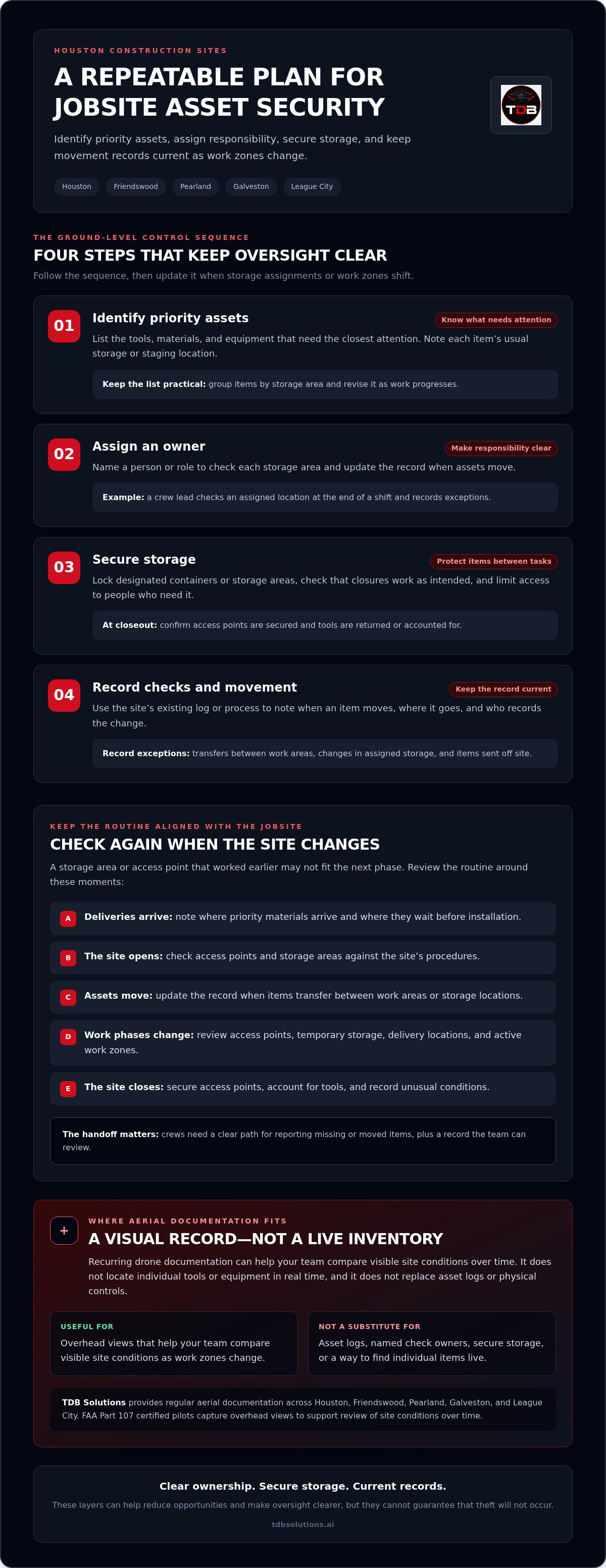
Turn the site plan into a working security routine. Identify exposed assets, assign responsibility, secure storage, and record checks and movements. Each layer addresses a different need: inventory tells your team what should be present, access routines help manage entry, and physical storage controls protect items when crews aren’t using them. No single control guarantees that theft cannot occur. Together, these steps make oversight clearer and help reduce opportunities.
- Identify priority assets. List the tools, materials, and equipment that need the closest attention. Note their usual storage or staging locations.
- Assign an owner. Name a person or role responsible for checking each storage area and updating the record when assets move.
- Secure storage. Lock designated containers or storage areas, and check that closures work as intended. Limit access to people who need it.
- Record checks and movement. Use the site’s existing log or process to note when an item moves, where it goes, and who records the change.
How should teams secure tools, materials, and equipment?
Keep the priority asset list practical and current. For example, a superintendent can group items by storage area and assign a crew lead to check each location at the end of a shift. Store equipment in its assigned location when it’s not in use, secure that area, and record exceptions, such as a tool moved to another crew. Adjust storage assignments as work progresses so the list reflects the current site.
Build asset movement into a process crews already follow. Record transfers between work areas, changes in assigned storage, and items sent off site. If an item goes missing, the team can review its last recorded location instead of starting with a search based on memory.
How can access and closeout routines reduce exposure?
Assign a responsible role for visitor sign-in and access-point checks. At opening, confirm that entry points and storage areas match your site’s procedures. At closeout, check that access points are secured, tools are returned or accounted for, and unusual conditions are recorded. Fit the routine to the site’s operating procedures, and update it when work zones or access arrangements change.
Set a clear reporting path. Tell crews who to notify when an item is missing, a storage area appears disturbed, or a site condition needs review. Record what was observed, when it was noticed, and who received the report. Timely documentation helps the team act on facts rather than assumptions.
Toolbox meeting checklist:
- Confirm priority assets and their assigned storage areas.
- Name the person or role responsible for each check.
- Review how crews record asset transfers and removals.
- Assign visitor sign-in and access-point checks.
- Confirm opening and closeout routines for the current phase.
- Review who receives reports about missing items or unusual conditions.
Adapt these steps to the site’s layout, work phase, and established procedures. TDB Solutions’ construction intelligence adds overhead context to your team’s view of changing site conditions, alongside physical controls and asset records.
Drone Asset Tracking vs. Cameras, Inventory Logs, and Site Inspections
Each monitoring method answers a different question. A camera records activity within its view. An inventory log records assigned items and documented movement. A site inspection checks conditions directly at a particular time. Recurring drone documentation adds an overhead view of the jobsite. It can help your team compare visible site conditions over time, but it doesn’t continuously locate individual tools, equipment, or materials.
What can aerial documentation reveal about a jobsite?
An overhead view can show the broader layout, visible staging areas, access routes, and changes to work zones. Compare records from different project phases to review whether visible materials or equipment appear in expected areas and whether temporary storage has shifted. This context can help supervisors decide where to direct an on-site check or update a site record.
Aerial imagery documents only what is visible during a flight. It won’t identify hidden items, confirm that an item has been removed, or match equipment to individual asset tags. The value of drone asset tracking construction sites Houston teams can review is consistent visual documentation, not live, item-by-item tracking. For more on how aerial records support project oversight, see this construction intelligence drone data guide.
When do other monitoring methods fill different gaps?
Choose methods based on the information your team needs and how often it needs it. Their roles can overlap, but one record shouldn’t stand in for another.
- Cameras: Record activity within their fixed views while operating. Their usefulness depends on placement, visibility, and whether important work areas fall outside the camera’s view.
- Inventory logs: Track assigned or recorded items and documented transfers. They depend on workers entering changes, so unrecorded movement can leave a gap.
- Site inspections: Give a person a direct view of conditions during the inspection. Staff can check specific storage areas and follow up on concerns, but the record describes conditions at that time rather than continuously.
- Aerial documentation: Captures a planned overhead view of visible site conditions. Repeated records help teams review layout and staging changes, but they don’t locate individual assets.
Use the methods together. An overhead record may show that a staging area changed; an inventory log can show whether a transfer was recorded; a camera may capture activity within its view; and a site inspection can check the location directly. If the records don’t line up, your team has a clear reason to review the discrepancy. Combining these methods gives you broader visibility without treating any single one as a guarantee.
Houston Jobsite Theft-Prevention Checklist for Each Project Phase
A theft-prevention routine needs to move with the project. Storage areas, delivery routes, and active work zones can change between mobilization and closeout, so build review points into the schedule. Assign each check to a role, then record completion in the project’s existing log or workflow. Adapt the details to your site rather than assuming a project in Houston has the same layout or risks as one in Friendswood, Pearland, Galveston, or League City.
What should teams check before and during mobilization?
Before work ramps up, mark access points, planned storage areas, delivery locations, and priority assets on a current site plan. Assign who receives deliveries, updates inventory records, and checks storage. Agree on how crew members report a missing item or unusual condition, including who receives the report and where it gets recorded. Keep the process simple enough to follow during active work.
Use this phase-based sequence to make the plan repeatable:
- Mobilization: The superintendent or assigned lead maps access and storage areas, identifies priority assets, and records the initial site arrangement.
- Routine operations: Assigned crew leads complete scheduled checks, note exceptions, and update asset records when items move between areas.
- Deliveries: The designated receiver records incoming items through the established inventory process, including where they are staged and who takes responsibility for them.
- Layout changes: The superintendent reviews the site plan when work zones, access arrangements, or storage locations change, then assigns any new checks.
- Closeout: The responsible lead checks assigned storage and priority assets, records unresolved discrepancies, and routes concerns through the agreed reporting process.
Keep the record consistent. A dated note in an existing daily report, inventory log, or project system can show who completed a check and flag a change that needs follow-up. The best format is the one your team already uses reliably.
How should teams maintain records through closeout?
Review site conditions at planned intervals and after significant layout changes, such as opening a new work area or moving a staging location. Compare current records with the site’s present arrangement. If your project uses recurring aerial documentation, treat it as visual context for reviewing visible site conditions, not as a substitute for inventory records or direct checks.
At project closeout, reconcile remaining priority items using your organization’s established process. Record outstanding issues and retain site plans, delivery notes, movement records, and completed checks according to your organization’s procedures. This creates a useful project record without requiring a separate system for each job.
A clear phase checklist gives your team a practical basis for including drone asset tracking construction sites Houston projects may use as one visibility layer within broader controls. To add recurring aerial documentation and construction intelligence to your project records, connect with TDB Solutions about aerial site documentation.
How TDB Solutions Adds Aerial Site Intelligence to Houston Projects
Aerial documentation adds another view to your theft-prevention plan. It gives your team a recurring record of visible site conditions, so you can review how staging areas, work zones, and project activity change over time. Use those records to support site discussions and direct follow-up checks. Aerial views complement access procedures and inventory records; they don’t locate individual assets live or physically deter theft.
What does construction intelligence contribute to site oversight?
Repeated overhead records help your team compare site conditions across project phases. If a staging area shifts or a work zone changes, those views can inform conversations about site organization and what needs a closer ground-level check. The goal is better visual context for your project team, not a replacement for inventory controls, direct inspections, or security procedures.
TDB Solutions provides aerial documentation and construction intelligence for Houston-area projects. Depending on project needs, deliverables include:
- Regular aerial documentation to record visible site conditions over time.
- Site progress reports to give your team an organized view of project progress.
- Volumetric measurements as a separate project data deliverable.
- Overhead oversight to help teams review broader site layout and changing conditions.
These records can connect a visual change with a project discussion: Is a staging area still serving its planned purpose? Has a work zone shifted in a way that changes where materials sit? The aerial record can help your team see and discuss those conditions. Your assigned staff still confirm what’s on site and update asset logs.
How can Houston-area teams take the next step?
TDB Solutions serves construction projects in Houston, Friendswood, Pearland, Galveston, and League City. FAA Part 107 certified pilots perform every flight, and the service carries liability insurance. Founder Dillon Bates brings over 10 years of survey experience to the work, applying careful technical observation to aerial project documentation.
For drone asset tracking construction sites Houston teams are planning, describe your project location, current phase, and the aerial documentation you want to review. That context helps shape a useful record around your site’s layout and oversight needs. Contact TDB Solutions to discuss aerial documentation for your construction project and add a clear visual layer to your existing prevention plan.
Put Your Site Oversight Plan Into Motion
Your next step is to turn project visibility into a routine your team can adjust as the job changes. Review the checklist at your next planning meeting. Decide what information would make decisions easier, who needs to see it, and how aerial records can fit into your existing project workflow. Keep the focus on useful documentation, not technology for its own sake.
A practical approach to drone asset tracking construction sites Houston teams manage starts with a clear purpose for each record. Choose the views and reporting details that help your team discuss site organization, review visible changes, and plan follow-up checks. Revisit the approach when project needs shift so it remains useful from one phase to the next.
Ready to add aerial visibility to your project workflow? Discuss aerial documentation for your Houston-area construction project with TDB Solutions and give your team a clearer visual record as the site evolves.
Frequently Asked Questions
Can a drone prevent construction-site theft by itself?
No. A drone can add visual context, but it can’t control entry, secure a storage container, or establish who accessed an area. If a crew finds a storage location disturbed, follow the site’s reporting process, review relevant access and inventory records, and document what staff observed. Treat aerial views as supporting information, not a replacement for physical controls or a guarantee against loss.
Does drone asset tracking show the live location of every tool or piece of equipment?
No. Aerial imagery records visible conditions during a flight; it doesn’t continuously locate individual assets. A practical drone asset tracking construction sites Houston workflow pairs overhead views with item-level records maintained by the project team. For example, record a tool’s assigned storage area and document transfers between crews. Staff can then check the item’s recorded history instead of mistaking a site image for live location data.
How often should a construction site receive aerial documentation?
Set the schedule around the decisions your team needs to make. If staging areas or work zones change often, a consistent documentation cadence can make comparisons easier. You can also plan a review after a major layout change, such as opening a new work area. Agree on the purpose, timing, and who reviews each record, then adjust the schedule as project activity changes.
Are drone photos enough to document construction-site theft?
No. Photos may help show visible site conditions, but they don’t establish a complete incident timeline or identify what happened outside the captured view. If an item goes missing, follow your organization’s reporting process and note when the issue was discovered, where the item was last recorded, and what staff observed. Keep aerial images as supporting context alongside relevant inventory and access records, without drawing conclusions the records can’t support.
What should a Houston construction-site theft-prevention checklist include?
Include priority assets, storage assignments, delivery and movement records, access responsibilities, and opening and closing checks. Make the checklist usable in a toolbox meeting by assigning each task to a role and naming where staff record completion. Identify what should trigger a follow-up review, such as a changed staging area or an unrecorded transfer. Update the checklist when project conditions shift.
Can aerial documentation help when a project spans multiple Houston-area locations?
Yes. TDB Solutions can provide visual records for multiple sites as part of a project’s documentation plan. Your team can compare visible conditions across locations while maintaining separate access procedures and inventory records for each jobsite. Align documentation goals and review processes across projects, while accounting for each location’s distinct layout and work phase. Aerial imagery supports site-level review, but it doesn’t replace item-level tracking.


