
An in-house drone pilot can be the wrong fit if your flight schedule is uneven. But outsourcing can fall short when projects need frequent, closely coordinated coverage. The decision in hiring in-house drone pilot vs outsourcing to TDB Solutions comes down to more than who owns the drone. It depends on flight frequency, internal capacity, required deliverables, and the consistency your team needs.
You need dependable aerial information without adding a role you can’t keep busy or managing every flight detail yourself. This article compares staffing, capabilities, consistency, and project fit, then explains how TDB Solutions supports construction teams with progress reports, volumetric measurements, aerial inspections, and overhead oversight.
Use the comparison to assess your workload and the support available in Houston, Friendswood, Pearland, Galveston, and League City. TDB Solutions’ flights are performed by FAA Part 107 certified pilots with liability insurance, and founder Dillon Bates brings over 10 years of survey experience. Most shoots are delivered within 24 hours of the flight, while most inspections are completed within 1-2 business days of booking. Consider these details alongside your project’s requirements and timing.
Key Takeaways
- Match your staffing model to the work. Recurring construction documentation may call for a different setup than occasional inspections or marketing flights.
- Account for the full in-house workflow, including flight planning, site coordination, data handling, and review of deliverables.
- Compare hiring an in-house drone pilot with outsourcing to TDB Solutions by workload, scheduling, expertise, deliverables, and management responsibility.
- Before choosing, define the outputs you need, estimate flight frequency, and decide who will manage requirements and review results.
- Consider how construction progress tracking, aerial inspections, and marketing media could support your Houston-area projects.
Hiring In-House Drone Pilot vs Outsourcing to TDB Solutions: Start With the Work You Need Done
Start with the work, not the job title. If your construction team needs repeat aerial documentation tied to project milestones, you may need dependable coverage and consistent outputs over time. If you need a roof assessment, property images, or marketing footage only occasionally, bringing in a specialist for each project may fit better than creating an ongoing internal role. The right answer to hiring in-house drone pilot vs outsourcing to TDB Solutions depends on what your team needs aerial information to do.
Outsourced commercial drone services provide flights and related aerial deliverables through an outside specialist when your project needs them. The pilot captures information for a defined purpose, such as construction progress tracking, an aerial inspection, or marketing media.
What does your drone work need to produce?
Begin with the decision the information must support. A project manager reviewing progress may need repeatable site images or a progress report. A facilities team assessing a roof may need clear aerial views of specific areas. A construction team reviewing stockpiles may need volumetric measurements, not just photographs.
Separate visual media from technical outputs before comparing staffing options:
- Imagery: Aerial photos or video for property listings, marketing, or visual records.
- Inspection views: Images that help your team examine a roof or other structure remotely.
- Project information: Progress reports, volumetric measurements, or overhead oversight that support site decisions.
A drone, also called an Unmanned aerial vehicle (UAV), can serve different purposes, so define the output before choosing who will operate it. For more on construction-focused deliverables, read the construction intelligence drone data guide.
How often will your team need flights?
Estimate frequency from the project schedule and reporting requirements. Review upcoming milestones, how often stakeholders need updates, and whether the same site needs repeat documentation. Avoid assuming a steady workload if project or inspection needs change.
Sort the work into a practical pattern: predictable visits for recurring documentation, one-time capture for a specific inspection or marketing need, or changing demand across projects. Then compare that pattern with the deliverables you need. Flight frequency matters, but it doesn’t tell the whole story. A less frequent flight may still require technical measurements or careful coordination, while repeat imagery may be simpler to review. Define both the schedule and the required outputs before deciding whether to build internal capacity or bring in a specialist.
What Hiring an In-House Drone Pilot Requires Beyond Flying
An in-house pilot is one part of an ongoing operating process. Your team still needs to plan each flight, coordinate with the project site, handle captured files, and get results to the people who need them. If those steps have no clear owner, aerial footage can arrive without answering a useful project question.
Piloting skill gets the aircraft and camera through a capture. Turning that capture into useful project information takes clear requirements, organized data, and review tied to decisions.
Can an internal pilot support your full workflow?
Map out the work around the flight. Who schedules it? Who identifies the areas or progress milestones to capture? Who organizes the resulting files and makes sure project managers, facilities teams, or marketing staff can use them?
Your answer may depend on the deliverable. Progress reports and volumetric measurements need review by people who understand the project context. An aerial inspection needs someone to identify the areas of interest and share the imagery with the right decision-makers. Marketing media needs a clear audience and purpose. The pilot can capture the material, but your business must decide how it gets reviewed and used.
When does building internal capacity make sense?
Frequent, predictable work can make an internal workflow worth assessing, especially if your team needs regular site access, direct scheduling control, or close coordination with established project routines. Familiarity with internal processes may help your team plan captures around milestones and share information through existing channels.
Before hiring, check whether you can consistently support the full cycle:
- Plan: Set the flight purpose, timing, and capture requirements.
- Coordinate: Keep site contacts informed and align the capture with project activity.
- Review: Organize the results and confirm they answer the original question.
- Share: Get relevant imagery or information to the people making decisions.
Hiring gives you an internal resource, but it doesn’t transfer responsibility for quality or continuity. Your business still needs to define what good results look like, maintain the workflow, and decide how the information supports project decisions. If you’re weighing those responsibilities against outside support, review TDB Solutions’ construction intelligence and aerial inspection services as one option.
In-House Pilot vs. TDB Solutions: Compare the Work, Not Just the Operator
Compare how each option fits your actual workflow. An in-house pilot may offer direct access and familiarity with your sites, while an outside provider can bring relevant experience when a project needs aerial work. Neither model fits every company. The useful comparison is who can deliver the right information on the schedule your work requires, and who will manage each part of the process.
| Criteria | In-house pilot | TDB Solutions |
|---|---|---|
| Workload | Consider whether your team has a steady stream of flights and the internal capacity to keep the workflow moving. | Construction intelligence, progress tracking, aerial inspections, and marketing media support defined project needs. |
| Scheduling | Your team coordinates flights around site activity and internal priorities. | Confirm timing and coordination for the specific project with the provider. |
| Expertise | Assess the pilot’s credentials and relevant experience for your intended work. | Flights use FAA Part 107 certified pilots with liability insurance. Founder Dillon Bates brings over 10 years of survey experience. |
| Deliverables | Your team defines, organizes, and reviews the outputs. | Work may include progress reports, volumetric measurements, inspection imagery, or marketing media, depending on project needs. |
| Management | Your business manages workflow consistency and continuity. | You still define project requirements and review deliverables, while the provider handles the flight work. |
Which comparison criteria matter most?
Look beyond flight count. Ask whether your work calls for recurring site visits, changing capture requirements, or consistent outputs across project updates. Then specify what those outputs mean: aerial photos for visual review, progress reports for project tracking, or volumetric measurements for a quantity-related decision. Verify the pilot’s credentials and relevant technical experience against those needs, rather than treating certification alone as proof of fit.
What does outsourcing to TDB Solutions include?
TDB Solutions serves Houston-area projects with construction intelligence, progress tracking, aerial inspections, and marketing media. Most shoots are delivered within 24 hours of the flight. For an inspection-focused project, review the Houston drone roof inspection guide to consider the questions and imagery involved.
The right model depends on workflow fit. When comparing hiring an in-house drone pilot with outsourcing to TDB Solutions, consider the work each option can support, the deliverables you need, and who will manage quality and continuity. Then choose the approach that aligns with your project schedule and internal capacity.
Use This Decision Framework for Your Houston-Area Drone Work
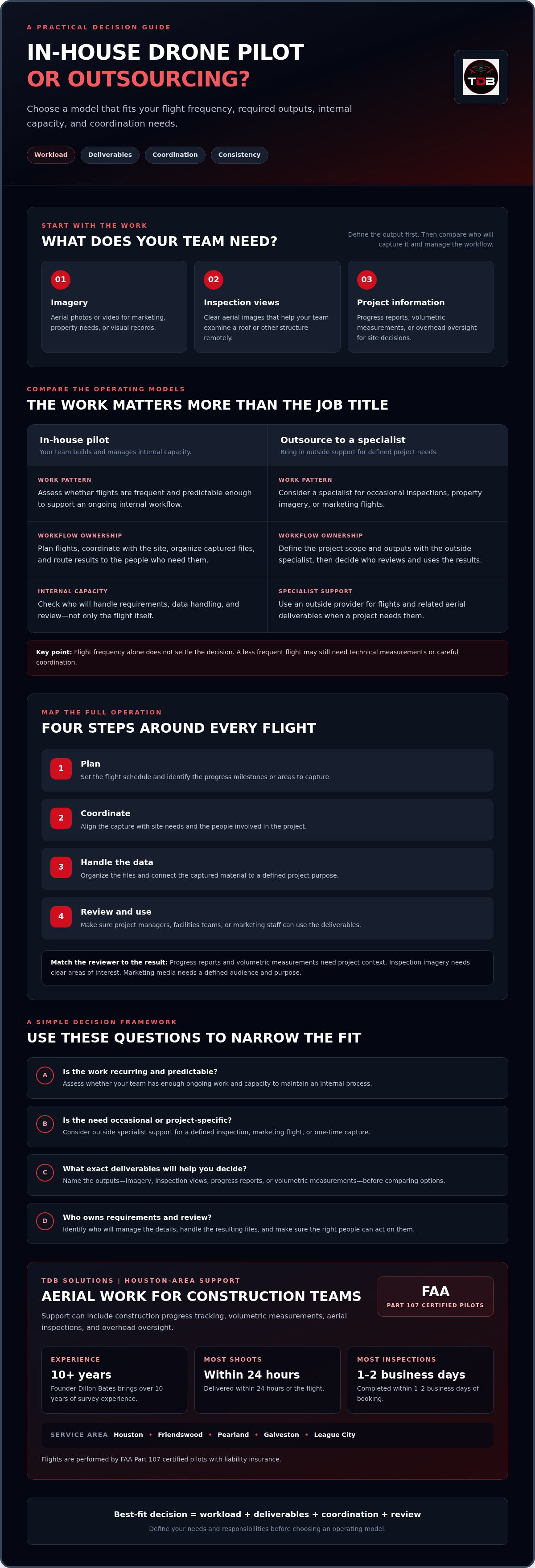
Make the choice in order. Define the information you need, estimate how often you need it, assign ownership of the workflow, then compare providers against those requirements. This keeps the decision focused on project needs, not assumptions about whether an employee or outside specialist is always the better fit.
- Define the outputs: Name the deliverable, such as progress documentation, inspection imagery, or marketing media.
- Estimate frequency: Check project schedules and reporting needs to see whether flights will be predictable, occasional, or variable.
- Assign ownership: Decide who will schedule flights, set capture requirements, organize files, and review results.
- Compare providers: Check relevant experience, credentials, deliverables, service area, and stated turnaround.
Be honest about capacity. Can your team consistently coordinate site access, explain what the pilot needs to capture, and review each deliverable in time to support a decision? If not, include that gap in your comparison. The work doesn’t end at takeoff.
When should you keep drone work in-house?
Assess an internal role when flights are frequent, predictable, and closely tied to daily operations. An employee may have easier access to your team’s project context and scheduling priorities. But internal staffing still requires a documented process for planning captures, coordinating with sites, organizing files, and checking quality. Familiarity helps, but it doesn’t replace clear ownership or consistent review.
When should you evaluate an outside provider?
Consider an outside provider when flight needs vary across projects or call for relevant construction or inspection experience. Compare qualifications and liability insurance, ask which deliverables match your objectives, and confirm that the provider serves your location. TDB Solutions serves Houston, Friendswood, Pearland, Galveston, and League City. Flights are performed by FAA Part 107 certified pilots, and most shoots are delivered within 24 hours of the flight. Confirm current scheduling and delivery details for your project.
For construction-focused planning, review the Houston construction drone data services guide. It can help you clarify what aerial documentation should support before you compare options.
The hiring in-house drone pilot vs outsourcing to TDB Solutions decision comes down to workload and workflow ownership. If outsourced construction intelligence or aerial inspections fit your needs, contact TDB Solutions to discuss your project requirements.
What to Expect When Outsourcing Drone Work to TDB Solutions
Once you know the work and outputs you need, share those details with a provider. TDB Solutions serves Houston-area projects with construction progress tracking, aerial inspections, and marketing media. The assignment may involve repeat site documentation, an aerial look at a roof, or photos and video for a property or business. Clear goals help the team understand what the flight should capture and what information you need back.
Timing depends on the type of work. Most inspections are completed within 1-2 business days of booking. This is a different timeline from shoot delivery after a flight. Ask how the current timeline applies to your project, including the flight schedule and specific deliverables.
What information should you share before requesting a project discussion?
Prepare a short project brief. You don’t need every detail finalized, but useful context helps set clear expectations. Include:
- Site and location: Identify the project or property and whether it is in Houston, Friendswood, Pearland, Galveston, or League City.
- Purpose: Explain whether you need construction intelligence, an aerial inspection, or marketing media.
- Desired outputs: Specify whether your team needs imagery, progress documentation, a report, volumetric measurements, or overhead oversight.
- Frequency: Note whether you expect one flight, recurring updates, or a schedule that may change.
- Timing questions: Ask how the stated turnaround applies to your flight and requested deliverables.
Specific requirements help you assess whether the service matches the decision you need to make. For example, if you need a roof assessment, explain which areas your team wants to review. For construction tracking, identify the progress information stakeholders need from each update.
How do you take the next step?
For companies weighing hiring an in-house drone pilot against outsourcing to TDB Solutions, a project discussion can clarify whether the service fits the actual workflow. Share your project purpose, location, anticipated flight frequency, and expected outputs. Flights use FAA Part 107 certified pilots with liability insurance. Founder Dillon Bates brings over 10 years of survey experience and leads the company’s aerial project work.
Have a Houston-area project in mind? Discuss your Houston-area drone project with TDB Solutions.
Choose the Drone Workflow That Fits Your Projects
The right decision in hiring an in-house drone pilot vs outsourcing to TDB Solutions starts with your deliverables, flight frequency, and your team’s capacity to manage each step. An in-house pilot may suit frequent, predictable work that connects closely to daily operations. Outsourcing may fit changing project needs or specialized construction documentation, aerial inspections, and marketing media.
For work in Houston, Friendswood, Pearland, Galveston, or League City, TDB Solutions provides access to FAA Part 107 certified pilots with liability insurance. Founder Dillon Bates brings over 10 years of survey experience. Consider these credentials and the stated timelines alongside your project requirements, then confirm how the service fits your site and requested outputs.
Bring your goals, location, and anticipated flight schedule to the conversation. Discuss your Houston-area drone project with TDB Solutions and explore an approach that fits the work ahead. Clear requirements are a strong first step toward useful aerial information and more confident project decisions.
Frequently Asked Questions
Is it better to hire an in-house drone pilot or outsource drone work?
Neither option is better for every business. An in-house pilot may fit frequent, predictable flights that connect closely to daily operations, provided your team can manage planning, coordination, and deliverable review. Outsourcing may suit occasional work or changing project needs. When comparing hiring an in-house drone pilot with outsourcing to TDB Solutions, weigh your required outputs and flight schedule against your internal capacity.
Can an in-house drone pilot handle construction progress tracking and inspections?
Yes, an in-house pilot can support progress tracking and aerial inspections if the team can manage the full workflow. Define what each flight should capture, who coordinates site access, and who reviews the results. Progress tracking may require consistent documentation and reports, while an inspection may call for imagery of specific structures or areas. The pilot’s experience should match the technical needs of the work.
What should a business compare when choosing an outsourced drone provider?
Compare the provider’s relevant experience, pilot credentials, liability insurance, service area, deliverables, and stated turnaround. Ask whether the provider can address your specific need, such as construction progress tracking, volumetric measurements, aerial inspections, or marketing media. Also clarify how you’ll share capture requirements and review the results. For a Houston-area project, confirm that the provider serves your location and can discuss the schedule you need.
How quickly does TDB Solutions deliver drone photos or inspection work?
Most shoots are delivered within 24 hours of the flight, while most inspections are completed within 1-2 business days of booking. These are different timelines: one refers to delivery after a shoot’s flight, while the other refers to completing an inspection after booking. Ask TDB Solutions how the current timing applies to your project and requested inspection or media deliverables.
Does TDB Solutions serve Houston, Friendswood, Pearland, Galveston, and League City?
Yes. TDB Solutions serves Houston, Friendswood, Pearland, Galveston, and League City. The company’s local coverage is relevant if your construction site, property, or facility is in one of these communities. Share the exact project location when you reach out so the team can confirm service coverage and discuss the work, whether you need construction intelligence, an aerial inspection, or marketing media.
Are TDB Solutions drone pilots FAA Part 107 certified and insured?
Yes. TDB Solutions flights are performed by FAA Part 107 certified pilots with liability insurance. These are practical details to verify when evaluating an aerial provider, alongside experience that matches your project. Founder Dillon Bates brings over 10 years of survey experience, which informs the company’s construction intelligence, progress tracking, and aerial inspection work.
What information should I provide when contacting TDB Solutions about a drone project?
Share the site location, project purpose, desired deliverables, and expected flight frequency. Specify whether you’re looking for construction progress tracking, an aerial inspection, or marketing media. If you need progress reports, imagery, or volumetric measurements, name those outputs so the team can understand your requirements. Include your preferred timing and ask how the stated turnaround applies to the project. Clear details help focus the discussion.


